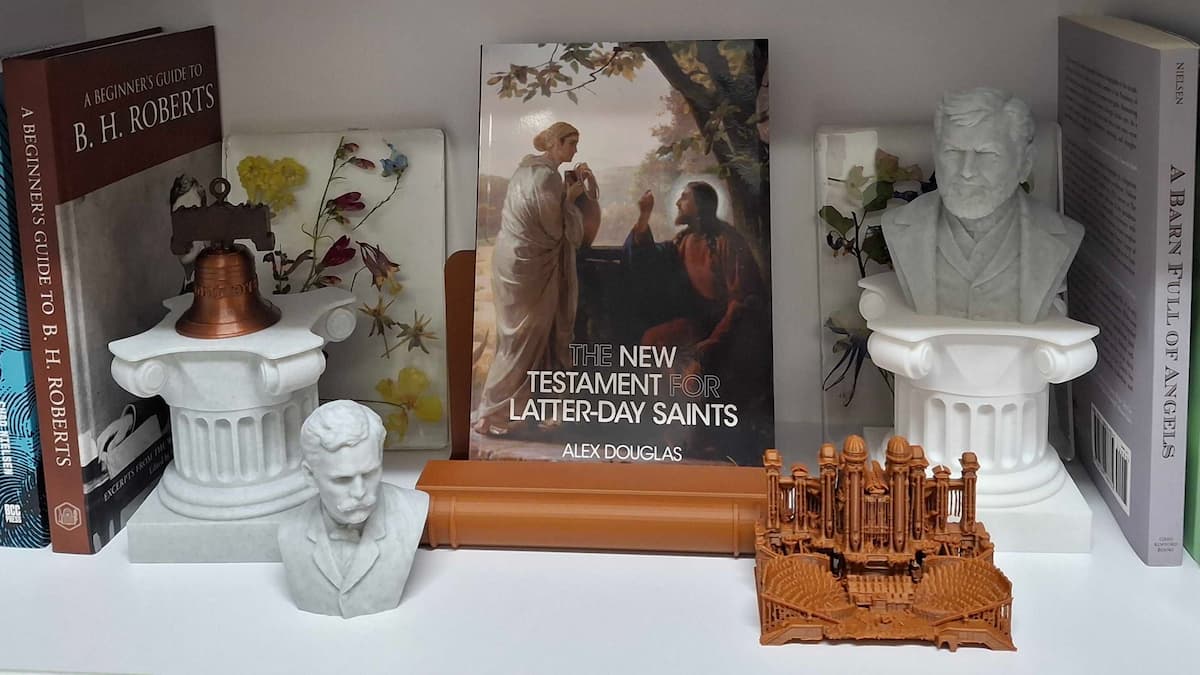
A review of Alex Douglas. The New Testament for Latter-day Saints. Salt Lake City: Signature Books, 2026.
For many Latter-day Saints, reading the New Testament often defaults to a harmonizing exercise. It is not uncommon to move through the Gospels during a Come, Follow Me year looking to blend Matthew, Mark, Luke, and John into a single, cohesive portrait of Jesus, smoothing over the seams and resolving apparent contradictions. In The New Testament for Latter-day Saints, biblical scholar Alex Douglas invites readers to set aside that impulse and instead engage the New Testament texts on their own terms, and to view it as “wartime literature”—a vital, fiercely contested collection of texts produced by diverse, vulnerable communities struggling to make sense of Jesus’s identity and mission in the wake of the crucifixion.
Douglas’s central aim is to introduce modern biblical criticism to a Latter-day Saint readership without an overabundance of the academic jargon that often keeps these insights locked in university seminars. The result is an accessible, intellectually honest work that encourages readers to let individual biblical authors speak for themselves.
Fractured Communities and Familiar Echoes
For me, one of the most effective pedagogical strategies Douglas employs is drawing parallels between early Christianity and familiar chapters in Latter-day Saint history. After Jesus’s death, the nascent movement fractured into competing groups like Jewish Christians, Gentile converts, Docetists, Gnostics, and early proto-Orthodox factions—each articulating a distinct understanding of what it meant for Jesus of Nazareth to be God’s anointed.
Douglas compares this early landscape to the aftermath of Joseph Smith’s martyrdom in 1844. Just as the death of the founding prophet prompted distinct factions in the following years (led by Brigham Young, Sidney Rigdon, James Strang, Joseph Smith III, and others) to produce texts and theological frameworks reflecting their specific visions of the Restoration, the writers of the New Testament produced works shaped by the social and theological views of their respective communities. This analogy grounds complex historical-critical concepts in terms that make sense for people who are familiar with the Latter Day Saint succession crisis.
Distinct Christologies and Ancient “Correlation”
Rather than presenting the New Testament as a monolithic theological manual, Douglas breaks down how each author crafts a unique portrait of Christ. For example, Douglas traces the “lower Christology” of Mark—where Jesus’s humanity and suffering are stark—which is different than the polished, orderly historical framing of Luke, and contrasts both with the high, divine Christology of the Gospel of John, which shares intriguing thematic overlaps with early mystical and Gnostic traditions.
Meanwhile, for Paul, writing earlier than the Gospel evangelists, the central focus remains fixed on the cosmic, transformative power of the resurrected Christ, whose triumph enables human beings to transcend their fallen nature.
Not every epistle that bears Paul’s name, however, can reliably be traced to Paul. Douglas demonstrates how later epistles reflect an emerging proto-Orthodox desire for stability and institutional order. In a dynamic that Latter-day Saints might recognize as an ancient counterpart to the Church’s 20th-century correlation movement, this push for standardization brought increasing hierarchy and directly curtailed the roles women had held in the earliest Christian house churches.
Navigating Faith, Scholarship, and Context
Douglas is open about his own position: he no longer actively associates with the Church of Jesus Christ of Latter-day Saints. For some readers, this transparency might raise immediate hesitation. However, Douglas approaches the material with deep sensitivity toward lay members that he developed as a Sunday School teacher and through years of experience as a member of the Church. He avoids beligerantly adopting an adversarial posture, taking care to distinguish between the conclusions of academic scholarship and the commitments of religious devotion. Thus, Douglas does not argue that traditional faith claims are inherently wrong; rather, he clarifies that conflating historical scholarship with theological dogma does a disservice to both. By explicitly leaving room for personal faith while illuminating some of the best scholarship on the historical environment of the early texts, he grants readers the autonomy to decide how modern scholarship informs their spiritual lives.
Situating Douglas in Latter-day Saint Scholarship
The New Testament for Latter-day Saints fits into an evolving library of LDS biblical scholarship. Signature Books previously explored this territory decades ago with Obert C. Tanner, Lewis M. Rogers, and Sterling M. McMurrin’s volume Compared to Toward Understanding the New Testament (1990). While that book laid essential groundwork, Douglas’s study benefits from more than thirty years of intervening biblical scholarship. It is also more compact, accessible, and explicitly geared to modern Latter-day Saint cultural touchstones.
A competing book entering the market this year is Seven Crossings by Adam Miller and Rosalynde Welch. This recent offering from Deseret Book also leaned into the communal origins of the Gospels. However, where Miller and Welch adopt a largely pastoral, theological lens designed for devotional reflection, Douglas leans more into the technical, historical debates and challenges readers to sit with the historical messiness of the ancient texts.
Although Douglas centers his analysis on the New Testament, his work also fits naturally into the ongoing re-examination of the Great Apostasy within Latter-day Saint scholarship. Volumes such as Standing Apart: Mormon Historical Consciousness and the Concept of Apostasy and Ancient Christians: An Introduction for Latter-day Saints have sought to complicate the rigid, twentieth-century narrative of an abrupt, total apostasy by recovering the genuine devotion, theological richness, and complexity of early and medieval Christian communities. As an example of congruence here, Douglas participates in this broader reassessment by charting how early egalitarian movements gradually gave way to patriarchal hierarchy and the marginalization of women, similar to the work of Ariel Bybee Laughton in Ancient Christians. One thing Douglas does particularly well is illustrating just how fractured and pluralistic early Christianity was, which indicates that the proto-Orthodox faction that ultimately won out was not the only—nor necessarily the most authentic—expression of the Jesus movement. At the same time, he gently pushes beyond the comfort zone of typical faithful retellings, noting that historical evidence suggests Jesus likely never established a formal institutional hierarchy during his mortal ministry at all, prompting readers to fundamentally rethink what an “apostasy” from early Christianity actually means.
In any case, Douglas has produced a clear and timely guide for Latter-day Saints ready to move beyond harmonization and proof-texting. By allowing the New Testament writers to inhabit their own worlds, The New Testament for Latter-day Saints shows that the early Christian struggle to define Jesus was messy, complicated, and deeply human—and all the more compelling for it.
Leave a Reply