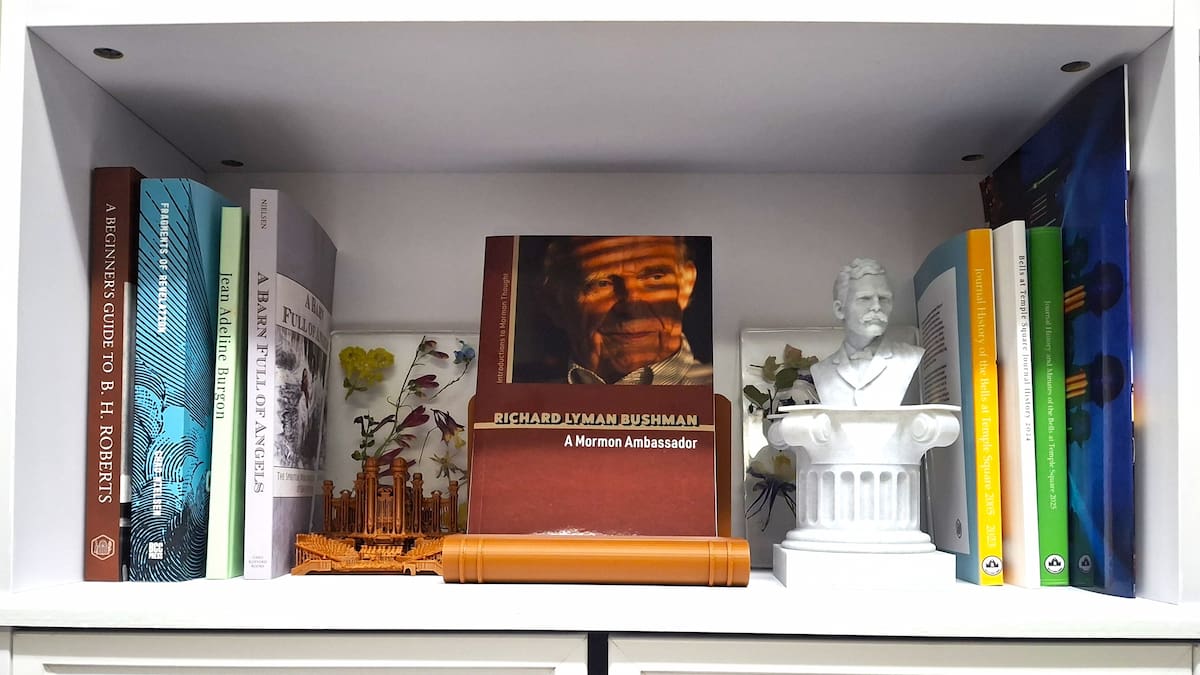
J. B. Haws. Richard Lyman Bushman: A Mormon Ambassador. Introductions to Mormon Thought. Urbana: University of Illinois Press, 2026. 157 pp. Paperback: $17.95. ISBN: 978-0-252-08935-0.
Reviewed by Chad L. Nielsen
Within the landscape of modern American religious historiography, few scholars have navigated the boundary between confessional commitment and critical academic rigor as deftly as Richard Lyman Bushman. As the Gouverneur Morris Professor of History Emeritus at Columbia University and one of the preeminent biographers of Joseph Smith, Bushman has long served as an intellectual bridge between the secular academy and the Church of Jesus Christ of Latter-day Saints. In Richard Lyman Bushman: A Mormon Ambassador, published as part of the University of Illinois Press’s Introductions to Mormon Thought series, J. B. Haws—executive director of the Neal A. Maxwell Institute for Religious Scholarship—makes a compelling case for Bushman as one of the towering architects of twentieth- and twenty-first-century Latter-day Saint thought.
Haws structures his volume with a biographical and geographical rhythm, organizing Bushman’s sprawling intellectual life around three primary roles and locales: Historian (Boston), Theologian (Salt Lake City), and Mentor (New York City). Rather than presenting a dry intellectual abstract, Haws demonstrates how Bushman’s intellectual output is fundamentally inseparable from his lived religious practice.
The Pastoral Scholar and Confessional Rigor
One of the volume’s most valuable achievements is Haws’s foregrounding of Bushman’s deeply pastoral nature. Alongside his Ivy League professorships and Bancroft Prize-winning early American scholarship, Bushman spent decades serving as a missionary, bishop, stake president, and patriarch. Haws illustrates how these ecclesiastical roles directly informed Bushman’s scholarship, transforming him into an accessible counselor for generations of Latter-day Saints navigating faith crises sparked by historical complexities.
At the core of Bushman’s intellectual ethos was a controversial, pioneering willingness to make his own faith a transparent element of his scholarship. Rather than adopting the detached, secular naturalism standard in university departments, Bushman practiced an empathetic phenomenology of the past. He sought to understand historical actors—most famously Joseph Smith—from the inside out, seeing the world through their visionary, nineteenth-century eyes rather than imposing modern materialist explanations. As Haws observes, Bushman operated as a “gentle provocateur,” convinced that placing Latter-day Saint claims into rigorous comparative dialogue with world traditions would always illuminate truth rather than destroy it.
Navigating the Hierarchy: Packer and Institutional Ambivalence
For students of Mormon intellectual history, the most fascinating section of the book examines Bushman’s complex interactions with the Church’s leading councils. In historical lore, Elder Boyd K. Packer has often been cast as the great antagonist of the “New Mormon History” and its practitioners. Haws, however, provides a nuanced, three-dimensional reappraisal of this relationship. He shows that Packer’s public and private cautions to historians were not merely anti-intellectual broadsides; they frequently probed genuine methodological concerns about audience, reductionism, and faith that Bushman himself wrestled with as a believer-historian.
Furthermore, Haws highlights Bushman’s distinctive theology of church governance. Unlike dissidents who engaged in public polemics, Bushman cultivated a deliberate posture of ecclesiastical deference, viewing subordination to priesthood authority not as intellectual surrender, but as an authentic expression of covenant discipleship.
Yet, Haws does not obscure the sharp ironies and administrative ambivalence that characterized this relationship. A striking case study is the ill-fated sixteen-volume sesquicentennial history series planned in the 1970s by Church Historian Leonard J. Arrington. Church leadership ultimately shut down the series, largely out of institutional discomfort with Bushman’s assigned contribution, Joseph Smith and the Origins of Mormonism. In a subsequent institutional paradox, after the volume was released independently by the University of Illinois Press to widespread scholarly acclaim, the Church purchased 14,000 copies to distribute to university and public libraries nationwide.
An Overlooked Interlocutor: Claudia Bushman
While Haws’s praise for Bushman is well earned, the volume contains one noticeable lacuna: the lack of sustained engagement with the intellectual influence of Claudia Lauper Bushman. Claudia appears in the opening biographical chapter as Richard’s courtship partner, is noted for raising apostolic eyebrows when she served as editor of Exponent II during Richard’s tenure as a stake president, and receives brief mention in the bibliographic essay.
However, given that Claudia is herself a distinguished historian, an early architect of Mormon feminist studies, and a pioneer of Latter-day Saint women’s history, one would have expected a deeper investigation into how her scholarship and feminist convictions shaped Richard’s own work. In an intellectual marriage spanning over six decades, how did Claudia’s historiographical sensibilities challenge, inform, or refine Richard’s theological and historical frameworks? Exploring their intellectual synergy would have provided a richer, more collaborative portrait of his scholarship and mentoring networks. (Though, I do understand that space in these books are extremely limited.)
Conclusion
For readers like myself, who have felt Bushman’s impact firsthand—whether through the expansive biography of Joseph Smith: Rough Stone Rolling or the personal vulnerability of On the Road with Joseph Smith—Haws’s biography is an illuminating and accessible work. J. B. Haws has given us a concise, fluidly written portrait of a scholar who proved that one could maintain rigorous academic standards without sacrificing devotional loyalty. Richard Lyman Bushman: A Mormon Ambassador is an essential acquisition for scholars of American religious history, Mormon Studies, and any believer seeking an intellectual template for faithful discipleship in an era of historical complexity.
Leave a Reply