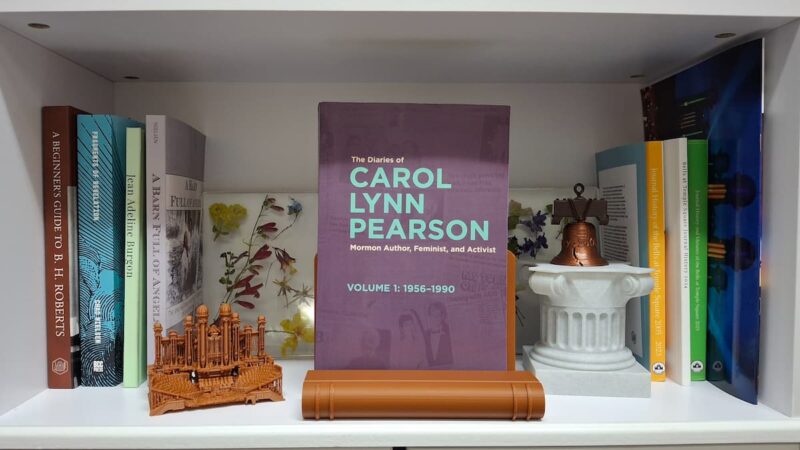
Carol Lynn Pearson. The Diaries of Carol Lynn Pearson: Mormon Author, Feminist, and Activist, Volume 1: 1956–1990. Salt Lake City: Signature Books, 2025. 419 pp. Paperback: $29.95. ISBN: 978-1-56085-524-8.
Reviewed by Chad L. Nielsen
As a Latter-day Saint coming of age in the latter half of the twentieth century, the creative output of Carol Lynn Pearson was somewhat ubiquitous to me, even if her central role in shaping the tradition’s devotional culture was not always consciously recognized. Whether singing “Follow, Follow Me” from her landmark 1974 musical My Turn on Earth, teaching children the tender inclusivity of the Primary anthem “I’ll Walk with You,” reading her insightful poetry, or grappling with the searing historical critique of The Ghost of Eternal Polygamy, I have felt the impact of Pearson’s writing as part of the cultural atmosphere of modern Mormonism. In The Diaries of Carol Lynn Pearson: Mormon Author, Feminist, and Activist, Volume 1: 1956–1990, Signature Books inaugurates a projected four-volume series that demonstrates just how foundational Pearson’s life and observations are to understanding the social, institutional, and emotional history of modern Latter-day Saint life.
These diaries will be essential reading for major historiographical treatments, like Benjamin E. Park’s American Zion or studies of general authorities like Marion D. Hanks. This published record particularly serves as an indispensable documentary companion to the era of correlation, the Equal Rights Amendment battles, and the early years of the HIV/AIDS epidemic.
The Self-Conscious Diarist and Co-Ownership of Zion
As with any major published diary, this collection represents a curated distillation of a much larger private archive spanning decades. What distinguishes Pearson’s journal from casual memoir is the author’s early, explicit awareness of the historical weight of her own pen. What began in the late 1950s as personal, therapeutic sense-making—she noted early on that “I find the more of my life I can put down on paper, the more of my life I can understand”—eventually transformed into an intentional act of documentary preservation. By 1979, having attained national prominence, Pearson recorded: “I know now that my diary will one day be important as a Church document. Having seen the importance of the early journals, and recognizing the amount of influence I have already obtained, I could not possibly deny that” (p. 58).
Far from vanity, this assessment is vindicated by the text. As a moderately liberal Latter-day Saint who keenly feels concern about women’s institutional standing and worries over the structural marginalization of LGBTQ+ individuals while wanting to remain a part of the Church, I found her thoughts and experiences to be very relatable. Pearson writes not as an alienated dissenter throwing stones from the perimeter, but from a fierce, grounded stance of internal co-ownership: “I believe this Church belongs to me too, not just to somebody in Salt Lake City. I have a huge ancestral, emotional, spiritual, financial investment in this Church, and I consider it my right and my obligation to do everything I can to help the Church be everything good that it can be” (p. 294). This moral clarity anchors her prose. Pearson can simultaneously cut through mid-century nationalist exceptionalism—”From the air most countries look pretty much alike. The land of America is just part of the soil of the earth. And the people of America are just part of the people of the earth” (p. 16)—while affirming a profound appreciation for communal lay solidarity: “I have always known that one of the best features of the Church is how it can mobilize people to help one another in times of need. I am very grateful” (p. 217). Her feminism is equally direct and unpretentious: “As for me and my house—we’re not at present in a great state of wondering what a woman is supposed to be. A woman is supposed to be a person—a good, kind, loving, trusting, confident person. The end” (p. 24).
The Institutional Engine: Apostles, Retrenchment, and Allies
One of the volume’s most valuable historical contributions is its unfiltered, behind-the-scenes view of general authorities and general officers of the Church during the contentious retrenchment of the 1970s and 1980s. In these pages, church governance is demythologized into an arena of competing ideological factions, personal temperaments, and bureaucratic anxieties.
Elder Boyd K. Packer emerges as the primary conservative foil of the narrative, cast in the formidable, antagonistic role familiar to readers of modern Mormon intellectual history. Pearson documents his hostility toward feminist and intellectual expression with biting specificity: blacklisting her for asserting that women exist for purposes beyond childbearing and facilitating male salvation; declaring that “the priesthood doesn’t support the Relief Society; the Relief Society supports the priesthood”; brutally telling gay men that “you’d be better off dead”; and leading an aggressive, abortive attempt in 1983 to purge the Church of individuals associated with Dialogue and Sunstone, which was halted only when Gordon B. Hinckley intervened. Elder Marion D. Hanks memorably captures the frustration of trying to dialogue with him, remarking to Pearson that “That man’s head is as impenetrable as an armadillo” (p. 59). While I wish the historical record allowed for a more three-dimensional, pastoral appraisal of Packer rather than the monolithic villain he often appears to be in progressive archives, Pearson’s diaries document actions that remain deeply painful to reckon with. Ezra Taft Benson makes fewer direct appearances, but his public sermons urging women out of the workplace cast a similarly suffocating institutional shadow across Pearson’s creative circles.
In stark contrast stands Pearson’s warm, enduring relationship with Marion D. Hanks, who functions as her pastoral anchor within the hierarchy. Hanks is depicted as a figure of extraordinary pastoral gentleness, remaining receptive to her concerns and supportive of her efforts, even as his own moderate, inclusive vision was progressively marginalized within the leading quorums. Jeffrey R. Holland appears in the early stages of his general authority service as a sympathetic, thoughtful successor to Hanks’s moderate tradition, candidly counseling patience by acknowledging that “the mills of the Gods grind slowly” when seeking structural reform (p. 65). Figures like Gordon B. Hinckley and Dallin H. Oaks are portrayed with nuanced ambivalence—pragmatic, sophisticated leaders capable of private sympathy and moderate administrative restraint, yet frequently enforcing institutional retrenchment when broader organizational discipline was demanded.
Queering the Restoration: Gerald, Spencer W. Kimball, and The Miracle of Forgiveness
The heart of the diary’s emotional and ethical gravity centers on Pearson’s marriage to Gerald Pearson, his quiet reality as a gay man in the Church during the mid-twentieth century, their eventual divorce, and his tragic death from AIDS in 1984 while being nursed in Carol Lynn’s home (a journey she famously narrated in her 1986 memoir Goodbye, I Love You, whose writing is documented in these diaries). The diaries contextualize this personal tragedy within the institutional pastoral practices of the era, providing disturbing glimpses into how ecclesiastical authorities handled queer members.
The portrayal of Spencer W. Kimball is particularly complex. While celebrated for receiving the 1978 revelation on the priesthood, his pastoral legacy regarding sexuality was experienced by gay Saints as devastating. Gerald’s visceral anger at Kimball’s public rhetoric and personal counsel captures this trauma: “I’m so angry at Spencer W. Kimball I could punch him in the nose. He has no right to make me and everybody like me feel dirty.”
Perhaps the most historically explosive detail in the volume is a 1979 entry recording the experience of a gay student at Brigham Young University. Kimball informed the young man that in order to be forgiven and permitted to finish his degree, he was required to write weekly letters detailing his spiritual progress in overcoming his homosexual desires. Under immense pressure and the threat of academic expulsion, the student fabricated a fictitious narrative of successful heterosexual reorientation across these weekly dispatches. The tragic irony, as Pearson notes, is that these very fabricated letters of “triumph” were subsequently incorporated into Kimball’s influential book, The Miracle of Forgiveness, held up to queer Latter-day Saints as proof that their sexual orientation could be eradicated through sheer willpower and repentance (p. 133). Such revelations provide indispensable context for the profound psychological costs of the Church’s mid-century pastoral theology.
Conclusion
The Diaries of Carol Lynn Pearson, Volume 1 is an incredible documentary achievement. By preserving the texture of everyday Latter-day Saint life alongside high-level institutional friction, Pearson offers a roadmap for what it means to practice a critical, loving, and resilient faith within a living tradition. Her diaries demonstrate that the struggle for inclusion, theological nuance, and gender equity is not a recent import of the internet age, but has been waged for decades by Saints who refused to abandon the faith they built. Pearson’s theological ethos is ultimately captured in her own simple, profound observation: “Few of us will see God in a sacred grove, but all of us can and should see God in other people” (p. 291). For scholars of Mormon Studies, gender history, and American religious culture, this volume is an essential acquisition.
Leave a Reply