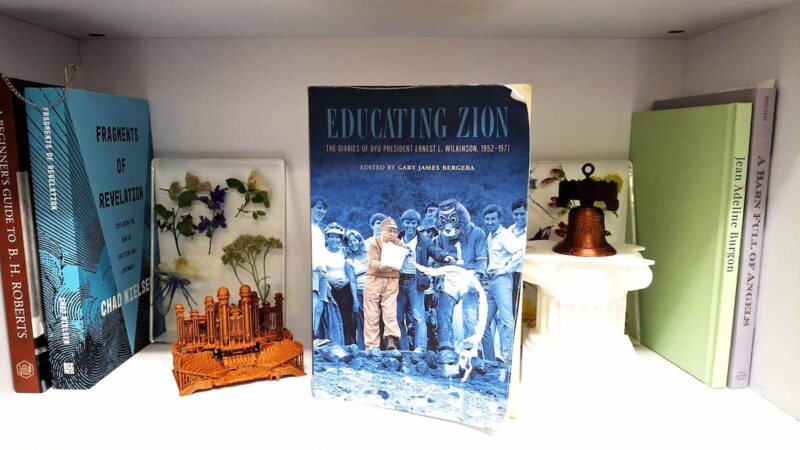
Gary James Bergera’s Educating Zion: The Diaries of BYU President Ernest L. Wilkinson, 1952–1971 won the Best Documentary Editing award at the Mormon History Association meeting this year, and the accolade is richly merited. Ernest L. Wilkinson served as the president of Brigham Young University for over two decades, presiding during a period of massive physical and enrollment expansion that coincided primarily with the administration of Church President David O. McKay. Wilkinson was a highly ambitious administrator with a background in law, who envisioned a vast, interconnected network of Church-run junior colleges spanning the Western United States. His frequent logs and records of regular meetings with the senior leadership of the Church offer an invaluable, behind-the-scenes glimpse into the institutional politics, administrative friction, and ecclesiastical policy decisions of mid-twentieth-century Mormonism. This archival richness explains why the Wilkinson diaries served as such a foundational source of information for Gregory A. Prince’s landmark biography, David O. McKay and the Rise of Modern Mormonism.
Although Bergera’s edition presents a curated selection rather than the full run of the diaries, it remains a monumental volume, spanning over 600 pages of main text. Fortunately, Wilkinson is a compelling narrator; his entries outline developing institutional and personal storylines that are remarkably gripping.
Inside the Administrative Engine Room
Educating Zion provides readers with a front-row seat to the development of major educational policies at BYU. The diaries document several fascinating and protracted debates, such as the years-long, localized conflict over whether to relocate Ricks College from Rexburg, Idaho, to Idaho Falls. They also trace Wilkinson’s ambitious, though ultimately unsuccessful, campaign to establish Church-controlled junior colleges in Arizona, California, and Oregon. Furthermore, the volume does not shy away from the darker episodes of Wilkinson’s tenure, detailing the fallout of his controversial student spy ring at BYU and the intense athletic and accreditation pressures the university faced due to the Church’s temple and priesthood restrictions on individuals of Black African descent and the closely related dearth of Black students at BYU.
Beyond policy, the diaries humanize the leading councils of the Church, offering unvarnished portraits of individual General Authorities. Wilkinson admired David O. McKay and J. Reuben Clark a lot, and that shines through. Meanwhile, Harold B. Lee appears as a formidable and frequently curmudgeonly figure, wielding immense administrative influence in committee meetings. The ideological chasm between the progressive Hugh B. Brown and the conservative Ezra Taft Benson is on full display, tracing their ongoing political feuds and Brown’s eventual marginalization within the governing councils. As J. Reuben Clark, David O. McKay, and Joseph Fielding Smith decline in physical and cognitive health over the course of the diaries, Wilkinson documents a growing administrative power vacuum that allowed competing agendas to clash without decisive oversight. This experience led a frustrated Wilkinson to privately record his belief that the President of the Church should be selected based on merit rather than seniority.
The Role of Critical Footnotes
Wilkinson is, of course, a highly biased chronicler of his own history, firmly convinced of his own rectitude and the correctness of his administrative decisions. Left uninterrupted, his diaries have the potential to present a highly one-sided narrative. One of the greatest benefits of this volume is Bergera’s invaluable footnoting. Drawing on decades of research into Wilkinson’s life and career, Bergera utilizes the broader archival record to annotate Wilkinson’s claims, providing necessary alternative perspectives and factual context where the president’s own accounts are partisan or incomplete.
Conclusion
All told, Educating Zion is an indispensable resource for anyone seeking to understand the institutional, political, and social developments of mid-twentieth-century Latter-day Saint history.
For info on more books being published in 2026, see Mormon Studies Books in 2026.
Comments
6 responses to “A Review: Educating Zion: The Diaries of BYU President Ernest L. Wilkinson, 1952–1971”
Will this lead to a biography?
It’s tempting.
Gary, your interview on Mormon Stories seemed overly kind to Wilkerson. You seemed to focus on the quantity of students, while barely mentioning the quality of the education and staff. Because of the tattletale environment, many bright Mormon educators wanted nothing to do with BYU. Which deprived the university of some potential high quality staff.
In DOM’s biography, Wilkinson is portrayed as a bit of a conniver. And the biography is not very kind to him.
The religion department was full of right-wing nuts. Anti-evolution, biblical literalists, etc.
For Wilkinson, a university was for indoctrination, not encouraging a free flow of ideas. Calling BYU the Harvard of the West was a joke. It was more like a Bob Jones of the West.
I tried hard in preparing the diaries to be as balanced as possible. I also wanted the diaries to speak for themselves, supplemented as needed by other contemporary materials. I think the introduction to the diaries may contain a more nuanced discussion of how I’ve come to view Wilkinson. He strikes me as a complicated man, driven by his own needs and insecurities to succeed. He accomplished a lot during his years at BYU. He–and others–also paid a high price for his singleness of vision. I guess one of the questions today is was it worth the cost? Could Wilkinson’s accomplishes been achieved differently?
It used to be that Mormons were one of the best educated religious groups in America. Yet BYU was unable to attract much of the Church’s top notch talent because of Wilkinson’s paranoia. It is sad that the university was willing to sacrifice talent for the sake of indoctrination. BYU had the potential to be so much more.
Could Wilkinson’s accomplishments been achieved some other way? Probably. For example, provides scholarships to all worthy college bound students. And have Institutes at a wide range US and global universities. The latter has been partially achieved.
So, it’s not like there’s a proven formula for turning a religious college into a nationally prominent university while maintaining its religious mission. A lot of colleges that started on that path have preserved at most a nominal religious identity and only a few ultimately succeeded. It makes no sense to dismiss concerns about secularization as paranoia when secularization has been one of the most important influences on society for the last century or more.