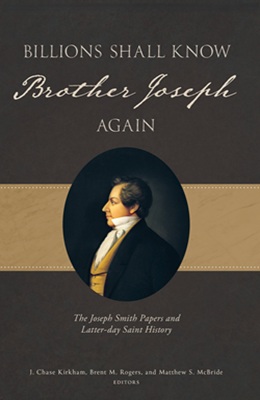
The completion of the twenty-seven-volume Joseph Smith Papers (JSP) project in 2023 was a watershed moment for the Church Historian’s Press, representing one of the most significant documentary editing feats in American religious history. Yet, as the project concludes its massive archival task, the question for the scholarly community and the lay membership alike shifts from one of preservation to one of application. In Billions Shall Know Brother Joseph Again: The Joseph Smith Papers and Latter-day Saint History, editors have gathered essays from the proceedings of the 2023 Joseph Smith Papers Conference to provide a vibrant “state of the union” for the use of the JSP in Mormon Studies.
One of the inherent risks in publishing conference compilations is a lack of thematic consistency or a tendency toward dry, overly specialized prose. This volume, however, avoids such pitfalls by maintaining a cadence that is remarkably short and punchy. The chapters move with brisk efficiency, making high-level historical research accessible to a broad audience. What emerges is less a eulogy for a finished project and more of a laboratory for how these thousands of pages of primary sources will be used to reconstruct the lived reality of the Restoration.
Illuminating the Gritty Realities of Zion
The strength of this collection lies in its ability to use the documentary record to solve specific historical puzzles. The standout chapters in this regard are those that dive into the complicated legal and financial machinery of the Nauvoo era. Jeff Mahas provides an essential and fascinating look at Emma Smith and the multi-layered conflict over Joseph Smith’s estate. For far too long, this narrative has been oversimplified as an interpersonal conflict between Emma Smith and Brigham Young; Mahas utilizes the JSP to highlight the genuine legal and personal tensions that followed the Martyrdom, offering a nuanced view of Emma’s precarious position and what she hoped to accomplish.
Complementing this is Elizabeth A. Kuehn’s in-depth exploration of financing the Nauvoo Temple through tithing. Her study transforms a dry subject—construction project accounting—into a compelling narrative of communal sacrifice on an international scale. These chapters demonstrate how the Joseph Smith papers can be applied to better understand the community of Latter-day Saints at the time more deeply.
The JSP in a Broader Scholarly Context
The volume also benefits from a wide variety of viewpoints, incorporating both the faithful and the interested outsider. Perhaps the most encouraging aspect of the volume is seeing how the project is interacting with the wider world of American history. Sara Martin’s chapter on the Adams Papers (for the John Adams family) provides a glimpse into the cross-pollination of documentary projects. Seeing the interplay between the papers of the “Founding Fathers” and the Joseph Smith Papers signals a significant shift in the academy: Joseph Smith is increasingly viewed not merely as a figure of parochial religious interest, but as a necessary component of the American narrative.
Conclusion
Billions Shall Know Brother Joseph Again is an excellent purchase for anyone interested in the “engine room” of Church history. Its chapters are digestible and of consistently high quality, making it a perfect companion for personal study or research. The volume proves that while the archival work of the JSP may be complete, our efforts to “know Brother Joseph” and his contemporaries are just entering a more sophisticated and rewarding phase.
For info on more books being published in 2026, see Mormon Studies Books in 2026.