McNeil, Maggie Eliza. “The Modern-Day Saints and the Battle of Doctrine and Domesticity: The Visibility of the Modern Mormon Woman.” Development (2026): 1-5.
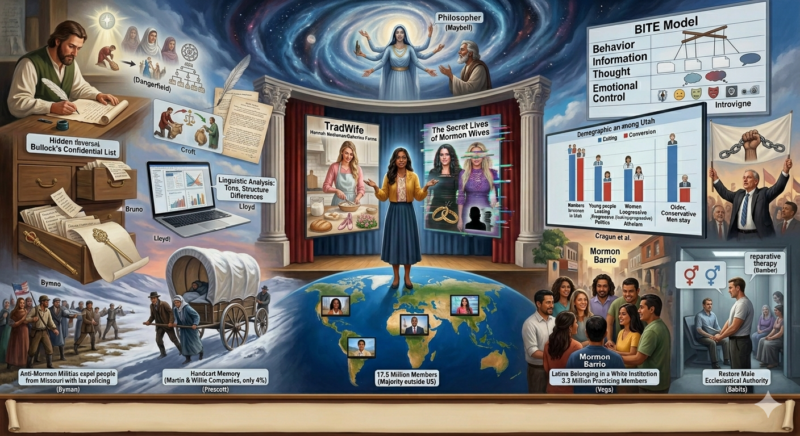
This article analyzes the contemporary and emerging identity of the Church of Jesus Christ of Latter-day Saints (LDS) as the Church delicately navigates between digital media representation, public fascination, and global spread. The popular representation of Mormons has been significantly altered by recent representations in reality-television and in digital media spaces– often highlighting taboo lifestyles that are rather antithetical to traditional LDS doctrine and behavior. The sex scandals and infidelity covered in The Secret Lives of Mormon Wives as well as the questionable choices of absurd characters in The Real Housewives of Salt Lake City directly contrast other popular images of Mormon women, like ‘TradWife’ influencer Hannah Neeleman, more popularly known as Ballerina Farms on social media platforms. This article aims to question whether any of these public caricatures accurately represent authentic Mormonism, or perhaps, whether there even exists any singular model of Mormonism in the modern age. By examining the Church’s demographic shifts— most notably that the majority of the 17.5 million members reside outside of the United States, many in African and Central/South American nations— it highlights the complex cultural negotiations faced by both international members, and the Church itself. By revisiting former concessions at the attempt of cultural assimilation, a hypothesis is constructed regarding the long-term negotiation between eternal doctrine and cultural survival.
Dangerfield, David. “Whiffing on Wifery: The Redefinition of “Spiritual Wives” and its Distortion of Church History.” Journal of Mormon Polygamy 2, no. 1 (2026): 113-133.
This paper critically examines the historical narrative surrounding the term “spiritual wifery” and its association with John C. Bennett’s activities in Nauvoo. The commonly accepted definition of “spiritual wifery” as illicit sexual relations kept secret is scrutinized and found to lack historical support. By analyzing primary sources, including Bennett’s letters and his book The History of the Saints, this study reveals that the term “spiritual wifery” has been misapplied and misunderstood. The paper argues that Bennett’s definition of “spiritual wifery” was more complex and structured, involving secret ceremonies and a hierarchical system. This misapplication has distorted the historical understanding of Mormon polygamy and Joseph Smith’s teachings. The article remains neutral regarding the veracity of claims made by historical figures on any side. The sole motive is to ascertain the correct definition of the “spiritual wife doctrine” as it relates to Mormon history. The paper calls for a reevaluation of the term “spiritual wifery” to gain a more accurate understanding of Latter-day Saint history.
Croft, Adrian. ““Unless the Lord Directs Otherwise”: Willard Richards and the Origins of Divine Reversal in Early Mormon Polygamy.” Journal of Mormon Polygamy 2, no. 1 (2026): 135-172.
This study examines the role of Willard Richards in shaping the textual and theological development of early Latter-day Saint teachings concerning plural marriage and moral authority. Drawing on manuscript evidence from journals, letters, revelation drafts, and the Nauvoo-era Manuscript History of the Church, the paper traces the emergence of a theological framework that may be described as radical conditional morality or “divine reversal”—the claim that actions ordinarily considered sinful can become righteous when commanded by direct revelation. While Joseph Smith’s public sermons and revelations consistently affirm fixed moral prohibitions and emphasize strict sexual morality, reversal-based reasoning appears most clearly in texts mediated through Richards’s hand as scribe, editor, or historian. These include private correspondence, draft documents containing conditional clauses not appearing in, or later inserted into public versions, retrospective editorial insertions in Joseph Smith’s journal, and involvement in the preservation and public transmission of the 1843 plural marriage revelation. By comparing earlier contemporaneous records with later edited forms, the study argues that the conceptual system underlying later plural marriage theology was not publicly articulated in Joseph Smith’s verified teachings but emerged through processes of clerical mediation and retrospective textual harmonization. Rather than attributing intentional fabrication to Richards, the paper situates his role within a broader pattern of nineteenth-century documentary compilation in which scribes functioned as interpreters as well as recorders. The case of early Mormon polygamy therefore illustrates how theological developments can enter institutional memory through the custodial authority of those responsible for preserving and organizing the historical record.
Introvigne, Massimo. “Steven Hassan and the “BITE Model”: Science or Pseudoscience?.” The Journal of Cesnur (2026).
The article examines the anti-cult theory of former Unification Church member and deprogrammer Steven Hassan, which he calls the BITE Model (Behavior, Information, Thought, and Emotional control). It argues that the BITE Model is simply Margaret Singer’s discredited theory of “cultic brainwashing” presented under a new name. Hassan claims the model proves the “cultic” nature of all groups he dislikes, from Latter-day Saints to the followers of Donald Trump. In the second part, the article reconstructs Hassan’s career, his involvement in forcible deprogramming, and the criticism he has received from scholars, courts, and even fellow anti-cultists.
Madsen, Grant, and Robert Reynolds. “Moral Foundations and the Rhetoric of General Conference Talks, 1860–2020.” Journal of Mormon History 52, no. 2 (2026): 75-156.
No abstract.
Prescott, Cynthia C. “Mormon Handcart Memory.” Journal of Mormon History 52, no. 2 (2026): 39-74.
Gemini-created abstract.
This article by Cynthia C. Prescott explores how the historical memory of the mid-nineteenth-century Mormon handcart migrations has evolved over time to serve shifting cultural and religious needs. Although handcart emigrants represented only about four percent of the total Latter-day Saint overland migration to Utah, their narrative—specifically the severe suffering and death experienced by the 1856 Martin and Willie companies—has become a disproportionately central symbol of modern Mormon identity.
Radke-Moss, Andrea G. “Monogamy on Display, Plurality Behind the Curtain: Emily S. Richards, May Booth Talmage, Susa Young Gates, Posthumous Sealings, and the Politics of Marital Representation at the 1893 World’s Congress of Representative Women.” Journal of Mormon History 52, no. 2 (2026): 1-40.
No abstract.
Maybell, Scott Ryan. “Heavenly Mother, If You Exist, Read this: Mormonism as a Mystical Atheism.” Topoi (2026): 1-10.
This article aims to accomplish two goals, one miniscule and one gargantuan. As a footnote to Brook Ziporyn’s Experiments in Mystical Atheism (2024), I show how his brief discussion about Mormonism can be expanded to read Mormonism as a part of the mystical atheist tradition Ziporyn constructs. By examining the ways Latter-day Saint thought understands divine persons as embodied, and the consequences of embodiment for classical forms of omniscience, I argue that Mormons can and should adopt a theology of time consonant with Ziporyn’s work. As an argument which directly addresses the creator as an equal, this article argues that atheist philosophers have the Luciferian task of trying to change the minds of divine beings, whether or not they exist, to argue against their pretensions of Absolute authority. Because mystical atheism argues that divine persons exist in the same oceanic swirl of global incoherence that all persons swim in, divine persons must be fallible in their knowledge, which means that alternative perspectives and good argumentation can and should change their minds.
Cragun, Ryan T., Bethany Gull, Michael Nielsen, Rick Phillips, and Jesse Smith. “The Demography of Exiting, Retention, and Conversion among Members of The Church of Jesus Christ of Latter-Day Saints in Utah.” Secular Studies 8, no. 1 (2026): 1-32.
Utah has a unique religious subculture that emerges from the historical and demographic prominence of The Church of Jesus Christ of Latter-day Saints (the LDS, or Mormon church). Scholars argue that in recent decades this subculture is eroding as disaffiliation from Mormonism rises. This paper examines the demography, social attitudes and religiosity of current and former Mormons to understand the dynamics of Utah’s shifting religious landscape. We find that current Mormons are better educated and more affluent than former Mormons. They are also more religious and politically conservative. By contrast, disaffiliating from Mormonism is concentrated among young people, and associated with progressive politics, especially on matters of sex and gender. Unlike studies conducted in previous decades, we find that women now leave the LDSChurch at least as frequently as men. Mormons who exit are more likely to abandon religion altogether than switch to another faith. We discuss the implication of these findings for the sociology of religion.
Byman, Daniel. “Religious Political Violence in Early 19th Century America.” Terrorism and Political Violence 38, no. 2 (2026): 169-182.
Nineteenth-century anti-Mormon expulsions in Missouri and anti-Catholic nativist violence in eastern cities constitute an overlooked but formative strand of American religious political violence. Contrary to Rapoport’s emphasis on apocalyptic or millenarian motivations, these campaigns were rooted in struggles over local political power and communal identity. Lax or partisan policing, sensationalist party-aligned newspapers, and a narrow definition of who counted as a legitimate “American” created permissive environments in which majority Protestant mobs wielded violence to disenfranchise, intimidate, and—in the Mormon case—physically expel religious minorities. The Mormon and Catholic experiences of the early 19th century have differences as well as similarities, in part shaped by Catholics’ nationwide dispersion versus the geographically concentrated Mormon community. The comparison demonstrates that American religious violence often advanced mainstream, not fringe, political agendas and that it blurred into ethnic and racial animus. Drawing these lessons forward, future scholarship and policy related to religious terrorism should focus less on spectacular terrorist acts and more on the structural drivers such as partisan media environments and poor policing that can contribute to conflict today.
Babits, Chris. “Masculinizing Mormon Patriarchs: A. Dean Byrd and Reparative Therapy with Latter-day Saint Men.” Church History (2026): 1-21.
This article analyzes how A. Dean Byrd, an assistant commissioner of LDS Social Services, advanced reparative therapy for Latter-day Saint (LDS) men at the turn of the twenty-first century. Byrd argued that Mormon men’s “unwanted same-sex attractions” stemmed from deficient gender identities that could be “repaired” by cultivating traditional masculinity. Rather than originating these ideas, he synthesized gender-essentialist themes from LDS pastoral discourse into a systematic therapeutic program grounded in the doctrine of eternal gender. Reading Byrd’s writings along the grain, this article shows how his model masculinized Mormon patriarchs while rendering women less visible as therapeutic subjects, framing conversion therapy in LDS contexts as a gendered project aimed at restoring male ecclesiastical authority. Byrd’s collaborations with Catholic and evangelical therapists through organizations such as the National Association for Research and Therapy of Homosexuality further reveal reparative therapy as a shared gender ideology that united conservative Mormons with a broader family values coalition amid a moral panic over homosexuality. Yet Byrd’s distinctly Mormon cosmology exposed the limits of conservative Christian ecumenism. Situating Byrd at the intersection of LDS soteriology, gender, and the religious right, this article illuminates how one Mormon therapist participated in and unsettled the networks shaping late twentieth-century responses to queer belonging.
Lloyd, Ethan. “A Detailed Linguistic Analysis of Doctrine and Covenants 132.” Journal of Mormon Polygamy 2, no. 1 (2026): 1-51.
The origin of Doctrine and Covenants 132 has long been disputed, but debates over its authorship have largely depended on conflicting historical memories and later narrative reconstructions. This study approaches the question from a different angle by examining how the text itself is written. Rather than asking what later witnesses claimed, it asks whether the language of D&C 132 resembles the language Joseph Smith consistently used in his other revelations. Using established techniques from computational linguistics to compare patterns of common words and sentence structure, this paper evaluates whether D&C 132 fits Joseph Smith’s known writing style. The results show that large portions of the text differ markedly from his authenticated revelations in tone, structure, and habitual word use. These differences persist even when controlling for subject matter, historical period, and genre, suggesting that they are not merely the result of topic or audience. While this study does not attempt to resolve every historical question surrounding the text’s transmission, it demonstrates that stylometric evidence offers an independent and measurable basis for reassessing the authorship and composition of Doctrine and Covenants 132.
Vega, Sujey. Mormon Barrio: Latino Belonging in the Church of Jesus Christ of Latter-day Saints. NYU Press, 2026.
Illuminates the unique struggles and triumphs of Latino Latter-day Saints, the second largest demographic group in the church
The Mormon community is usually thought of as a homogenous, white-dominant faith. However, Latinos make up the second largest demographic group in the Church, with about 3.3 million practicing members today. Despite their rich history and influence, little research has focused on Latinos within the LDS Church or the push-pull factors that have attracted Spanish-speaking members to Mormonism in record numbers.
Mormon Barrio charts the century-long history of Latino Latter-day Saints, examining their historic and present contributions to the Mormon faith as well as their unique positioning within the religion’s demographic makeup. Early in the Church’s history, founder Joseph Smith’s successor, Brigham Young, denied Black members full participation in the faith. Latino Saints existed somewhere between White and Black members in this system. Since the late 1970s the church has disavowed the belief that people with dark skin are inferior, but the Church is still an overwhelmingly white institution.
Centering the voices of Latino LDS members, the volume explores how Latino Mormons have navigated and established a sense of belonging for themselves within the faith, countering its Whiteness and coming to terms with its racist history. It shows how Latino Mormons have developed ethnoreligious barrios (communities) to function as sacred ethnic collectives where their religious beliefs and cultural practices can intersect. And it pays particular attention to gender, and to the ways in which Latina Mormons engage their faith and feminism to navigate their gendered positions within Mormonism. Mormon Barrio demystifies the lived ethno-religious experiences of Latino Mormons and accentuates their efforts to build a sense of communal belonging within their faith.
Bruno, Cheryl L. “Hidden in Plain Sight: A Rediscovered List of Joseph Smith’s Wives.” Journal of Mormon Polygamy 2, no. 1 (2026): 53-112.
This paper examines the recently rediscovered Bullock/Kimball 1854-1866 List of 33 Wives of Joseph Smith, a confidential document compiled in the Church Historian’s Office over a decade after Smith’s death. Created by Thomas Bullock, with later additions by Heber C. Kimball under the direction of early Church leaders, this list represents one of the earliest efforts to systematically document Joseph Smith’s plural marriages. Its discovery sheds new light on the ways in which women’s identities were recorded—or obscured—within the evolving institutional memory of Mormon polygamy.
By analyzing the historical context, purpose, and implications of this list, this paper explores how early Church leaders framed polygamous relationships within the broader narrative of religious authority and historical preservation. The mislabeling of the document exemplifies a recurring pattern in Mormon historiography, in which women’s experiences were subsumed within male-centered narratives of leadership and doctrine. Additionally, the paper considers how this document’s rediscovery contributes to contemporary discussions about the historiography of plural marriage, institutional memory, and the ongoing efforts to recover the voices of the women whose lives were shaped by these historical developments.
Wood, Nathan. “The Rhetorical Grounds of Wayne Booth’s Liberal Mormon Dissent: Uncommon, Hypocritical, and Emergent.” Rhetoric Society Quarterly (2026): 1-15.
Wayne C. Booth (1921–2005) frequently advocated for deliberative approaches to rhetoric that valorized listening, assent, and the pursuit of common ground. But toward the end of his life, Booth wrote five essays that recommended fellow progressive members of the Church of Jesus Christ of Latter-day Saints (Mormonism) pursue disagreements with the orthodox, not by deliberation, but by emphasizing their differences through dissent. This article documents those progressive Mormon essays and suggests they offer a rare glimpse at how Booth provided for the limitations of deliberative rhetoric. Moreover, then considering his personal journal entries about his faith, I show that Booth’s dissent also offers insights about the politics of emergent ground. Ultimately, then, Booth’s liberal Mormon dissent offers a look at the rhetorical options afforded to progressives mired within a conservative religious tradition, but also a primer on the limits of common ground and the affordances of emergent ground, generally.
Comments
9 responses to “Cutting Edge Latter-day Saint Research, March 2026”
The Demography article is more interesting to me and is available here: https://www.ryantcragun.com/the-demography-of-exiting-retention-and-conversion-among-members-of-the-church-of-jesus-christ-of-latter-day-saints-in-utah/amp/
OK the Demographics article is enjoyable, I love anything sociology of religion. One thing I want to understand is why Whites are overrepresented in exiters? Interesting it can’t be explained generally by SES.
Thanks again, Stephen. It looks like the Journal of Mormon History may want to consider including abstracts for its articles.
A lot of stuff on polygamy. That seems to be all the rage right now–especially during the Nauvoo period.
RL: I don’t see where it says that in the article, it looks like the lifers and leavers have a similar racial profile. Maybe I’m missing something?
Gary Bergera: Agreed. It’s probably making them miss out on readership. Sometimes the titles are descriptive enough one can kind of tell what they’re about by often not, and in today’s low attention span environment you’d think abstracts would be a no-brainer.
Jack: Some of that is a function of that new Journal of Mormon Polygamy. I’ve heard whispering about that Journal but nothing solid enough to repeat here in public, so I’m not sure what’s motivating a whole journal on that subject.
Stephen, thank you for yet another installment in your “cutting edge research” series.
These are much appreciated.
On the overrepresented white exiters, page 3,9.
Lifers outnumber converts 5:1. So for the average Utah member, 16.7% are a convert and 84.3% of that group is white. 83.3% are lifers are 95% of that group is white. Exiters are 96.6% white. Membership is 93.37% white and exiters are 96.6% white. How is whiteness coming into play for exiting if not explained in a confounding variable like SES?
I love that there’s finally an article in the language/rhetoric space — and on a subject similar to what I will be presenting on at Mormon Scholars in the Humanities in late May.
Going to be very interesting to read that article.
RL: For Table 1 I see that lifers are 95% white, exiters are 96.6% white, and converts are 84% white. So yes, converts do look like they’re less white than cradle Latter-day Saints, but I doubt the difference in race is significant between the exiters and lifers, since it’s only 1.6% different. The p-value is significant, but that’s for a chi-square that’s just testing whether the distribution as a whole, including the converts, is different, so it’s not specifically testing lifers versus leavers. So to make a long story short, I don’t really see a race story in who is leaving. Even though exiters are more white, it’s probably just noise.