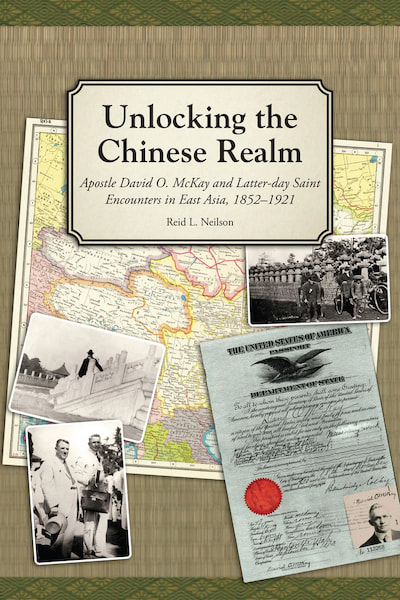
The history of the Church’s global mission is often viewed through the lens of individual apostolic journeys, few of which loom larger than David O. McKay’s 1921 world tour. In his latest work, Unlocking the Chinese Realm: Apostle David O. McKay and Latter-day Saint Encounters in East Asia, 1852–1921 (Greg Kofford Books, 2026), Reid L. Neilson offers a topical and deeply researched examination of the Church’s early efforts to establish a foothold in China.
Neilson has spent over two decades publishing on the Church in the Pacific and Asia, and this volume feels like the culmination of that long-term scholarly investment. Unlike a documentary history, this is it is a richly illustrated, topically organized narrative that situates the Latter-day Saint experience within the broader context of Western attitudes toward the “Orient” at the dawn of the twentieth century.
Biography vs. Specialty Study
Last year, readers were introduced to a broad view of McKay’s international influence in the biography Building a Global Zion: The Life and Vision of David O. McKay. Given the proximity of these publications, a central concern for many will be the degree of overlap. While both books necessarily cover McKay’s 1921 world tour, they serve distinct purposes. Where Building a Global Zion provides the wide-angle lens of a full life, focusing on McKay’s overall vision for a globalized faith, Unlocking the Chinese Realm functions as a high-powered zoom lens focused on the dedication of China for the preaching of the gospel in 1921. Neilson contextualizes the 1921 trip not just as a biographical milestone, but as the climax of a specific, multi-generational effort to engage with East Asia that echoed into the years that followed.
A Topical Deep Dive
Rather than a strictly linear travelogue, Neilson organizes the book topically. This allows him to explore the “pre-history” of McKay’s visit in satisfying detail. One chapter focuses on the 1852 mission to Hong Kong—a fascinating, if difficult, early attempt at missionary work. Others look at the mission to Japan and Alma O. Taylor’s crucial fact-finding mission to China. Because of this structure, there is an occasional but necessary chronological overlap, which Neilson manages well to ensure the reader understands the shifting geopolitical and ecclesiastical landscapes of the late nineteenth and early twentieth centuries.
The standout contribution of this volume is Neilson’s analysis of the apostolic ritual of dedicating lands. For many members, the dedication of a country is a familiar concept, but rarely has its history and theological significance been treated with such rigor. Neilson’s chapter on the history of dedicatory prayers is a masterclass in ritual studies, exploring how these acts served to symbolically “turn the key” and consecrate a nation and its people for the reception of the gospel.
In Neilson’s telling, David O. McKay’s 1921 prayer in Peking (Beijing) was not an isolated event but the culmination of decades of preparation. Neilson illuminates how McKay, as a young and vibrant apostle, viewed his mission as a preparatory act—consecrating the “Chinese Realm” in a way that resonated through subsequent generations of Church leaders.
Visual and Historical Richness
The book is richly illustrated, providing a visual dimension that makes the historical accounts of Taylor, McKay, and their contemporaries feel immediate. Neilson’s work is particularly effective in showing how these early encounters were shaped by broader Western attitudes toward the East, and how those attitudes evolved into the modern era: Neilson does not shy away from the broader cultural context of the era, examining how McKay and his contemporaries reflected—and sometimes challenged—the prevailing Western attitudes toward East Asia. The book is particularly valuable for its concluding insights into the decades following 1921, tracing how the “key” McKay turned continued to shape the Church’s hopes for China and its global diaspora into the modern era.
The final chapters of the book move beyond 1921, briefly tracing the legacy of McKay’s dedicatory prayer through the subsequent decades and into the present day through both subsequent dedicatory prayers in Asia and missionary work in portions of China. This gives the book a sense of continuity, showing how the foundations laid in the early 1900s still resonate in the Church’s current relationship with China and its global diaspora.
Conclusion
Unlocking the Chinese Realm is a rigorous and engaging study. It provides the specific historical scaffolding that a general biography cannot, making it a valuable companion for anyone seeking to understand the details of the Church’s entry into East Asia. Reid Neilson’s decades of research have resulted in a work that is both intellectually satisfying and an enjoyable read for those interested in the unfolding of the international Church.
Comments
One response to “A Review: Unlocking the Chinese Realm: Apostle David O. McKay and Latter-day Saint Encounters in East Asia, 1852–1921”
Thanks for another great review. I know someone who needs this on their Christmas list.