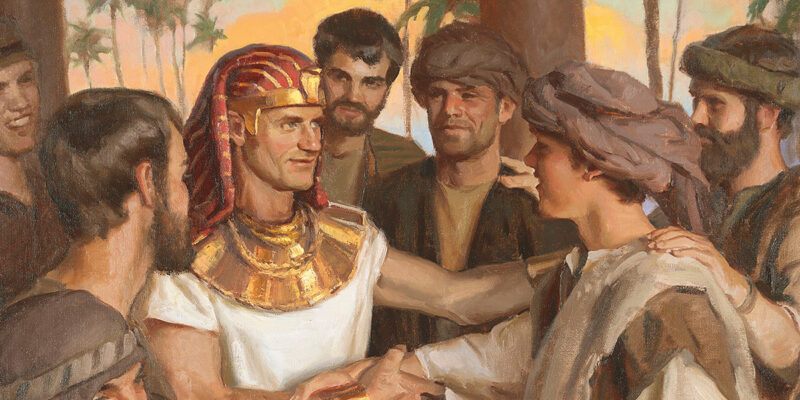
Given the famine described in the Bible, it is certainly fortunate that Joseph ended up in Egypt and in a position to help his family. His rise there to 2nd in the kingdom seems highly unlikely, something that might require the help of divinity to occur. And the explanation this lesson focuses on, “God meant it unto Good,” says that God was there, arranging circumstances so that Joseph would be in the right place to help BOTH his family and the nation of Egypt.
But it may be that the more significant blessing is the reconciliation that Joseph had with his siblings on their arrival in Egypt. That blessing, along with the blessing given by Jacob to his sons, and the later trials of their life in Egypt helped to unite the family and transform them into what would become a nation and a people. Too often nations are birthed in such strife and bloodshed. But without that, will the birth be successful? Will they consider themselves one people?
“God sent me before you to preserve you.”
What does the word “preserve” mean in this statement? If the family isn’t united, will they be preserved? I think we often limit the meaning here to some kind of physical survival—i.e., they didn’t die because Joseph got them food. But couldn’t “preserve” also be spiritual? Without what Israel learned from their reconciliation, would it have been preserved? Maybe there is a lesson in this for Israel today — can it survive without a reconciliation?
The following poem was published as a hymn in the 1840, 1841 and 1843 hymnals published in England.
When Joseph saw his brethren moved
by Parley P. Pratt
- When Joseph saw his brethren moved
- With keenest sorrow and distress,
- He could no longer hide his love,
- His warm emotions more suppress.
- The mystery he did unfold,
- Then fell upon their necks in tears,
- I am your brother whom ye sold,
- Dismiss your doubts, dispel your fears,
- ‘Twas God that sent me by command,
- To save you from the famine sore,
- To bring you into Egypt’s land,
- Where you shall never hunger more.
- What mingled feelings seized their breasts,
- Surprise, and grief, and joy, and love,
- And shame, and sorrow, and distress
- Alternate, did their feelings move.
- Lo! this a lively type shall be
- Of Joseph’s remnant long unknown,
- The Gentiles shall their glory see,
- When to their brethren they’re made known.
- A curse, a bye-word long they’ve been,
- Afflicted by the Gentile race,
- Plunder’d and driven, sold and slain,
- Or brought to shame and deep disgrace.
- But lo! their origin reveal’d,
- Brings blessings on the Gentile world,
- Their ancient records, long conceal’d,
- Are like a banner now unfurl’d.
1840
Forgiveness brings healing
I think the title of this section of the lesson says everything. To me, this section is the most important part of the lesson.
Not only is this poem on topic, it also makes me smile because of the poet’s name.
Forgiveness
by James Bond
- How sweet the charm that CHARITY imparts,
- And throws around our erring, human hearts;
- It dries the evils that man’s breast may tear,
- And calms, subdues the passions reigning there.
- FORGIVENESS! What a grace to be possessed!
- And he that has it may be doubly blessed;
- It sheds sweet peace around, dispelling strife,
- And stills the troubled sea of earthly life.
- FORGIVENESS wields the chain of brotherhood,
- And makes mankind approximate to God;
- Thus may we gain the attributes of heaven,
- And learn how to forgive and be forgiven
1854
Jacob gave his family prophetic blessings.
Parental blessings are an important and encouraged part of our belief. Regardless of who gives the blessing, they provide comfort, counsel and influence to help family members. And in the case of Israel, the blessings suggest how the tribes of Israel saw themselves, perhaps similar to how these blessings influence how we see ourselves.
Here, Eliza R. Snow muses about the Father’s role in giving blessings and helping the family.
A Patriarchal Ode
by Eliza R. Snow
- Blest is the man o’er his household presiding
- Fill’d with the spirit and wisdom of God
- Blest is the household where friendship and concord
- Like Eden’s sweet odors are spreading abroad
-
-
-
-
- Chorus
-
-
-
- Yours is the blessing of glory and honor
- Majesty, might and dominion spread wide
- Union and harmony, truth, and salvation
- In your habitation forever abide
- Prompt to perform what the Lord had appointed
- Bearing his standard to lands far away
- Gathering the scattered descendants of Abram
- Spreading the light of the glorious day
-
-
-
-
- Chorus. Yours is the blessing &c.
-
-
-
- Choosing the life that with God is eternal
- Seeking his counsel, and faithful to do
- Ever abiding the law that’s Celestial
- Keeping the manner of Glory in view
-
-
-
-
- Chorus. Yours is the blessing &c.
-
-
-
- Bound in the ties that unite us forever—
- Formed for eternity—sacred on earth
- Mingling with spirits so noble and heavenly
- Tempered with sweetness embodied in worth
-
-
-
-
- Chorus. Yours is the blessing &c.
-
-
-
1845
God can help me find meaning in my trials.
I sometimes think that the idea of how to confront trials shows up in every other lesson—perhaps because we do have trials, and perhaps even that often (depending on what you think is a trial). What trials mean is more difficult to figure out. Fortunately, the lesson hints that the meaning can be personal, what we understand it to be. And I think it is often best to let people believe what they believe about their trials. Let them find their own meaning, helped by what comes from the Lord.
Here Eliza R. Snow looks at the trials of the early Danish saints—missionary work began in Denmark just two years before this poem was written. The country had instituted religious freedom three years earlier, and many people there were still against that idea.
To the Saints in Denmark
By Eliza R. Snow
- All you who in Denmark believe on the Lord,
- Rejoice in His goodness, and trust in His word;
- Over all that oppress you and all that assail,
- If you will be faithful, you’ll surely prevail.
- The Lord is your portion; then be of good cheer—
- Though Satan is raging, you’ve nothing to fear:
- Whatever you suffer for righteousness’ sake
- Will add to the glory that you will partake.
- The crown of the martyr’s a glorious crown;
- And if for the Gospel your lives are laid down,
- An escort of angels your spirits will bear
- Where Joseph and Hyrum and Abraham are.
- In the midst of your trials be patient and meek,
- And the Spirit of God in humility seek,
- And seek for the wisdom that comes from above—
- Be as wise as the serpent, yet harmless as doves.
- Like gold in the furnace the Saints must be tried,
- Or the coming of Jesus they cannot abide,
- Neither dwell in His presence hereafter, nor claim
- A fulness of glory with God and the Lamb.
- We pray for your welfare; O be of good cheer!
- With shouts of hosanna we’ll welcome you here,
- And with you, in the Temple, His blessings partake
- Who will never, no never, His people forsake.
- Then endure with long-suffering, and wait for the day
- When God in His wisdom will open the way
- For the Saints who are suff’ring in Denmark to come,
- And enjoy in the mountains a peaceable home.
1852
“A seer shall the Lord my God raise up.”
Among LDS Church members, this statement is usually interpreted as a prophecy about Joseph Smith and his mission. Of the many poems that discuss Joseph’s role as a seer, I like this poem for its interesting associations and metaphors.
The Young Seer
by Anna Musser
- The lofty quiet of cathedrals
- May be as prayer, or it may be death,
- A dim-walled tomb for human seeking.
- Religion had been made incarnate,
- And the body, growing old, was still worshiped and exalted,
- And entombed.
- Color and movement, and the whole hushed music,
- Were all as for a funeral, drawing toward silence,
- Closing men’s eyes aforetime.
- Why did they make Death to be their God,
- And the sleep of death their peace?
- Life is everywhere, where laughter is permitted,
- For there is childhood, wide eyes and questions.
- There is laughter still for America’s youth,
- And the rawness of our farm-boy days,
- Our heritage all measureless, our future wholly marvelous,
- While our present was a lean log-house.
- There were wooded hills and valley lands,
- And any sons to work them,
- And reading of the Bible by the evening fire.
- And the matter of God could never be settled –
- Methodists and Baptists and staunch Presbyterians,
- Testifying, proselyting, arguing salvation.
- From among these men rose Joseph the Prophet,
- Young as America itself,
- Tall with a good inheritance,
- Intent with his race’s questioning,
- No longer to be turned aside.
- O young seer of the New World,
- Kneeling near the great trees and asking of God,
- Surely it is you who can save us at last
- From the darkness that came upon our fathers.
- Ere yet we grow to manhood and awareness of death,
- Teach us the full honest faith of youth,
- Lest we too turn and cower for shelter
- Within dark words and dark walls,
- Calling them sanctuary, worshiping of God.
1931