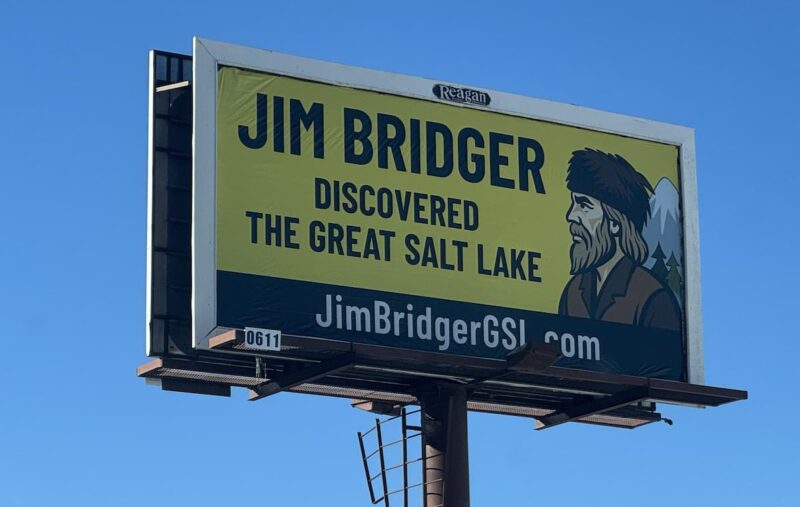
As I’ve been driving to and from work in Salt Lake City recently, I have noticed a new public history campaign popping up on signs along the road that states: “Jim Bridger discovered the Great Salt Lake.”
Coincidentally, these signs began appearing in my peripheral vision just as I was diving into Elise Boxer’s recently published book, Mormon Settler Colonialism: Inventing the Lamanite. The juxtaposition of reading Boxer’s academic analysis of how settler societies frame Indigenous peoples while simultaneously driving past literal signposts of settler-centric history has been jarring. It has prompted me to think deeply about the words we use on our public monuments and what those words require us to forget.
The problem with the word “Discovery” in 2026
I recently had a conversation with a friend about these signs. I initially offered the statement, “So, do the people who designed this sign think the Indigenous peoples who lived here for thousands of years didn’t notice the big body of salt water, or do they just think Indigenous peoples don’t really count as people.” My friend offered a generous, relatively common defense of the wording: “discover” is a fluid term. In the 1820s, the globe was not as well-connected. Therefore, for Euro-American society, Bridger’s encounter with the lake was a genuine discovery. On an individual or culturally isolated basis, the word holds up. If I find a great restaurant downtown that is new to me, I might tell my friends I “discovered” it, even though the chef has been cooking there for years.
I understand this perspective. If we view the sign purely through the subjective, isolated lens of 19th-century Euro-American expansion, the word “discover” seems innocuous. I also understand that the purpose of these signs is likely for research on the impact of billboards, so the Reagan company can convince people to use their services (though the ever-present possibility that their contract will be terminated early to make room for a Julia Reagan remembrance sign probably isn’t helpful to their cause).
But public monuments and signs do not exist in the 1820s. They exist in the present day, speaking to our modern, shared society.
If the sign’s intent is simply to highlight Bridger’s contribution to Euro-American geographic knowledge, historical precision demands a qualifier: “Jim Bridger was the first recorded White man to see the Great Salt Lake.” We are no longer isolated from other societies. The knowledge, history, and wisdom of the Indigenous nations in Utah are highly accessible to us, including their intimate knowledge of the Great Salt Lake that stretches back hundreds, if not thousands, of years before Bridger was born.
When we leave a word like “discovered” unqualified in 2026, it only functions if we implicitly assume that our present-day society is entirely disconnected from Indigenous history—that their pre-existing knowledge is somehow irrelevant to the “official” record. Returning to the restaurant metaphor, if I were to place a plaque on the downtown restaurant, proclaiming that it was “discovered by Chad Nielsen in 2026,” that might be relevant information for my family, but the people who have been eating at the restaurant for the last few decades would find it to be nonsensical.
The Myth of the “Empty Land” and Settler Colonialism
This is where Elise Boxer’s work becomes highly relevant. Reading Mormon Settler Colonialism clarifies that these linguistic choices are rarely just innocent shorthand; they are part of a broader framework of ongoing settler colonialism. One of the primary tactics employed in settler societies is the creation of historical narratives that assuage guilt and distance us from the moral responsibility to engage meaningfully with sovereign Indigenous nations today.
For example, a foundational trope of American expansion is the myth of the “empty land”—the idea that the West was a pristine, untouched wilderness waiting to be claimed, mapped, and made useful by White settlers. The Bridger sign plays directly into this trope. It frames the landscape as though no one was already here to know about the lake.
Furthermore, as Boxer and other historians point out, settler fantasies often relied on the dehumanizing notion that Indigenous peoples were not utilizing the land “productively,” thereby rendering them unworthy of holding it. By refusing to acknowledge the historical perspectives and geographic authority of the Shoshone, Goshute, and Ute peoples (or the Fremont before them) who already lived around and utilized the Great Salt Lake, public markers like this perpetuate that erasure. Bridger didn’t discover a hidden body of water; he stumbled into the heavily utilized homelands of complex, established societies.
Reclaiming a Shared History in Utah
Words matter, especially when they are literally written in bold letters and planted in the earth. If we want to build a historical memory that is honest, we have to move beyond the pioneer-centric myths of “discovery.” We can acknowledge Jim Bridger’s place in Western expansion without pretending he was the first person to open his eyes in the Salt Lake Valley. A more measured, historically rigorous public memory doesn’t erase Euro-American history—it simply places it in its proper, shared context.
For more on Jim Bridger, visit the From the Desk interview, Jim Bridger: Who Was the Mountain Man?
Comments
22 responses to “The “Jim Bridger Discovered the Great Salt Lake” Billboards and the Myth of the Empty West”
In a few years someone will stand in the exact spot Jim Bridger stood and “discover” The Great Salt Pit. It won’t be something the indigenous inhabitants had known about for millennia. A truly new geographical feature, bereft of water or any other redeeming features. Can we then put up a plaque?
I had the same reaction when I saw those billboards a few days ago.
A Turtle Named Mack, sure. If there’s anyone left alive here at that point to put one up.
Off-topic, I know, but your story reminds me of a class I took in early 1976 on Presidential Character in which the professor took note of “Reagan” popping up on billboards (he had never noticed it before) and speculating that it was a stealth campaign tactic on behalf of the Gipper.
I always appreciate every effort to combat our white supremacy/settler colonialism. Thank you for a thought-provoking post.
Joseph Priestley is said to have “discovered” oxygen in 1774, which he called “dephlogisticated air.” Lavoisier understood better what Priestley had discovered and named it oxygen in 1777. Oxygen had of course already been used by people for countless generations to burn fires and for respiration. Were we to consider simply breathing as intimate knowledge of oxygen then lizards, beetles, and some bacteria also have long had that intimate knowledge.
Gabriel Bowen, a professor at the U. of Utah, wrote a paper last year, “Multi-Millennial Context for Post-Colonial Hydroecological Change in Great Salt Lake.” His multi-millenial understanding of the lake comes from studying sediments. A line can be drawn from such work back to Stansbury, and from Stansbury to Fremont, and Fremont to Bridger. That is where that line begins. Bridger discovered the Great Salt Lake to the same extent that Priestley discovered oxygen. They both uncovered things and made them known to the world at large.
If we’re talking about deceptive language, “settler colonialism” is also a term that gets used to delegitimize the existence of certain people and erase a history of violent persecution. The Salt Lake Valley was the third option for the Saints after they had been expelled from Missouri and Nauvoo. We don’t have to love every part of their story, but what they built in Utah was undeniably impressive.
bmp, that part is well known and hasn’t been erased. Every history that I’ve read about Latter-day Saints and Native Americans admits that. And yes, I also take pride in many of the accomplishments of my pioneer ancestors. (I wouldn’t be publishing a biography of one of them in a couple months if that wasn’t the case.) But that doesn’t change that their settlement here came a huge cost in human life to the people who already lived here, much larger than the loss of life and resources that the Latter-day Saints endured in those previous persecutions. The Latter-day Saints came and took the land with the assumption that because of their race and religion, they had a right to do so. To me, that isn’t something I feel the need to defend as just and righteous, because it wasn’t. As you say, we don’t have to love every part of the story. It’s definately something that I feel conflicted over.
John Mansfield, sure. I will also note that the records of the Domínguez–Escalante expedition predate Bridger, which contains references to the Timpanogous tribe telling them about the Great Salt Lake, so there are other paper trails at play too.
“Settler colonialism” absolutely is deployed to delegitimize the existence and independence of certain peoples and I’m tired of pretending it doesn’t. One only needs to read Hemopereki Simon or Thomas Murphy to see that plain as day.
John Mansfield: Priestley and Lavoisier isolated and studied oxygen in ways not previously done. Priestly documented how to generate oxygen, and it’s effects on both mice and himself. What exactly did Bridger “discover” about Great Salt Lake? That it was big, wet and salty? Were the locals unaware of that?
Just to be precise, there is a difference between saying that a couple of articles and books delegitimize the existence of “certain people” and erase a history of violent persecution, and having scholarship question the historicity of the Book of Mormon and challenge how we have applied the idea of Lamanites to Indigenous peoples in the nineteenth, twentieth, and twenty-first centuries. To do so is an oversimplification.
I personally have mixed feelings about some of what those scholars say – particularly demands that the Church abandon the Book of Mormon. The Boxer book I mentioned in the post falls into a similar category, and you’ll see some of my mixed feelings about it when my review goes live in a couple of weeks.
At the same time, the violent persecutions that early Latter-day Saints experienced and the efforts of White Protestant Americans to force Mormons in Utah to follow their expectations about capitalism, marriage practices, and theocracy give me more sympathy towards the Indigenous peoples who experienced similar things, but more intensely:
When you think about scale, the Hawn’s Mill Massacre is the most widely known mass murder committed against Latter-day Saints, which killed around 17 people. We probably had a couple of dozen other people die in the Missouri exodus. Hundreds died on the way west to Utah, with the Martin and Willie Handcart companies being the most notable examples (though logistical challenges rather than direct persecution were at play there). But, by comparison, the Bear River Massacre alone killed 250 to 493 Shoshone people. The massacre was not carried out by Latter-day Saints, but it was done in “defense” of Latter-day settlers in Cache Valley. Likewise, during the Long Walk of the Navajo, up to 3,500 Dine people died from starvation and disease over four years. Again, that was another incident headed by the U.S. Army rather than Mormons, but was done, in part, because of complaints by Latter-day Saint settlers in the region during the Black Hawk War. Beyond deaths, there is also the concern of cultural genocide – we get upset about the efforts to end polygamy, communal living, and theocracy during the Raid, but as soon as those changes were made, the government got off our backs (even if conservative Evangelical Christians never have). Compare that with the history of Native Americans, who have had political autonomy challenged repeatedly, and faced efforts like the government boarding schools to strip children of their ancestral culture and ways of living, or “Kill the Indian in him, and save the man.” This was practiced well into the twentieth century. In fact, there are still a couple of Native American boarding schools in operation to this day.
This doesn’t undo or delegitimize that Latter-day Saints died in Missouri or that we faced violent persecution repeatedly throughout the nineteenth century, but I note this to explain why I feel some sympathy towards Indigenous peoples and patience about extreme expressions in their scholarship to make the point that they have faced a lot of violent persecution as well (both physical and cultural), are still feeling the effects of it, and would appreciate changes being made to improve the situation for them.
Ah, there’s the rub, isn’t it? What changes would actually improve the situation?
As far as the OP goes, I honestly don’t really care about defending Jim Bridger’s accolades. I don’t think litigating any “quantum of persecution” is very productive either. But I don’t see a way to satisfy those “extreme expressions” for which you have such patience. Their demands are eliminationist. It’s one thing to attack the historicity of the Book of Mormon…been there, done that, will doubtless see more of it. But they go past simply arguing that it’s not true. There’s no way to accomodate their demands without ceasing to be as a people, without disclaiming virtually everything that made us as evil. The only thing left of our common experience after we’ve satisfied them will be ancestral remorse, and self-abjuration, and maybe a casserole.
I would like to see how you square the circle, but perhaps that’s better left for the review of Boxer.
I understand what you’re saying, and have observed that in the writings. Maybe it’s because I’ve had to deal with corporate politics as a manager, but I see it as something where you push for extemes with a silent and more realistic expectation of just moving the needle a bit (with a touch of amplification by outrage and trauma). So, that is how I square that circle.
As far as changes, I generally try to leave that to the people affected to answer what they need that is doable (with the caveats that all government interventions are fraught and society is complicated and difficult to engineer). From what I’ve read, independence and acceptance to preserve their culture, better options for education, better access to healthy food and drink, and the ability to manage more of their traditional homelands (e.g., Bear Ears area), are some of the things they really want (as well as the occasional call for financial reparations). To the point of the OP, more honest and sympathetic portrayals of the history in public spaces would also be a nice start. But again, I don’t want to put words in their mouths.
Fair enough. If more incremental needle-pushing is the goal then it has had its effect, in me at least. But as a rule I tend to take rhetoric at its word. I’ll read your review of Boxer with some interest.
From a theological perspective, we could frame issues like this within the idea that each generation seeks forgiveness for the sins and shortcomings of its time. That concept is even reflected symbolically in the temple washing ordinance, which includes language about being cleansed from the sins of one’s generation. Approaching the question this way allows us to view the pioneers in a more complete light recognizing both their heroism and their failures without feeling forced to choose between the two. It provides a way to honor their courage and sacrifices while also acknowledging that they were not flawless.
I quite like that perspective, Carey. One of my BYU professors said something similar at the end of a class which was very heavily focused on racial reckoning. I suspect that will be summarily dismissed as “guilt prophylaxis” or some such Dan McClellan-ism by parties so inclined. But I suppose you can’t please everybody.
DaveW, you asked what Bridger discovered?
He discovered that the Bear River flows into a great body of salt water that he could speculate was the Gulf of California or some other arm of the Pacific Ocean. He discovered a question. That question was answered when the Sublette group explored the shoreline, followed up by Bonneville, and Washington Irving could publish in 1837 The Adventures of Captain Bonneville and let the public at large know, thirteen years after Bridger touched it, that a great salt lake exists in North America high above sea level. Bonneville through Irving estimated the elevation as “one and three-fourths mile above the level of the ocean.” Fremont in 1843 could with instruments significantly improve Bonneville’s elevation estimate. Finally, Stansbury received orders in 1849, twenty-five years after Bridger touched it, to spend the next couple years first surveying the Great Salt Lake and then compiling an extensive report on it.
I find all of that activity meaningful, part of an unfolding understanding of the North American continent that hasn’t stopped. Building knowledge involves step after step of work by many, and there are certain thresholds, often argued over, that get labelled “discovery.” Big hints of what may be discovered precede discovery, and vastly greater understanding developed by others will follow that.
From Jerry Enzler’s biography of Bridger, pp. 34-35, “The course of the Bear River is like a great question mark in its route, and so it was in the trappers’ minds. Where would it go next? Could it be the ‘Bonaventura,’ that mysterious river that rumor held might be the water passage to the west? They argued among themselves about the course of the Bear, and some trappers made a wager. Twenty-year old Bridger was selected to explore its course.”
[ . . . ]
“Then he saw it. The canyon walls fell away and the river flowed into a great expanse of water that expended for miles, its choppy waters dotted with whitecaps. He rode up to its shore and tasted it.”
That was a key moment in the history of the Great Basin and of North America, and I prefer to honor it instead of trying to bring it down a notch.
I can’t speak for the Reagan advertising company, but the Mormon pioneers didn’t believe in the myth of the empty west at all. They saw themselves in a place with thousands of years of human history.
Differences in productivity aren’t fantasy. If you want to understand reality, you have to face the harsh economic truth that industrial societies can maintain larger and denser populations than agricultural societies, which can maintain larger and denser populations that hunter/gatherer societies.
You might think that “settler colonialism” just means settlers founding colonies, but it actually implies a whole ideological framework that gives legitimacy to some people and denies it to others. The pioneers could just as reasonably be called “immigrants” or “refugees,” but that would recognize their moral right to exist and practice their religion that “settler colonialism” denies. The framework of “settler colonialism” has already been used to justify violence and it should not be treated as a simple descriptive term.
What’s interesting about this is that the billboard is not trying to teach history, it’s just trying to do market research for a billboard company. Jim Bridger is sort of irrelevant to that effort. It looks like they just picked him as almost a token figure to fill a role. What they’re doing is surveying who knows anything about Jim Bridger, and then leaving the billboards up for a month, and then doing another survey to develop data on the extent to which billboards are effective. The associated web site acknowledges that Jim Bridger may well have not found the lake, although its list of who the other possibilities were only lists white explorers. One thing is for sure: more people know who Julie Reagan is than used to know.
John Mansfield, those are some good points.
bmp, I am well aware of what is implied in settler colonialism. I am less aware of violence being justified by it (I trust you that it has happened, but I find it ironic, since the point of settler colonialism is to highlight a system of imposing violence on Indigenous peoples). As indicated in some of my other comments, I am not completely aligned or comfortable with the framework of settler colonialism, but I do think that scholars who speak from that framework do have some legitimate points, which is why I brought it up here.
That being said, even though I’ve offered some defense of what I said, please keep in mind that they way I wrote this post was that I read the book, which is definitely a settler colonialist critique of settler society, and felt like the sign was an interesting case-in-point example of what the book was saying that appeared at the same time I read it. When I’ve done more formal writing on the history of Latter-day Saint settlement in Utah, I’ve tried to be a bit more balanced and portray things from the perspective that is sympathetic to both the Latter-day Saints and to the Native peoples who lived here at the same time. I know it’s a reality that White settlers could sustain a denser population through agriculture and that if the Latter-day Saints didn’t do it, eventually other Americans would.
And to your statement, yes, the LDS pioneers were aware that there were people living in the land who had a long history in the region, but the issue is more around how they (and other American settlers) chose to tell the story of their settlement. I’ve read many autobiographical sketches and historical recollections of the pioneers, and it is not uncommon for them to talk about the land being a barren wilderness and only mentioning Native Americans to talk about either efforts to assimilate them or violent conflicts. Take, for example, the Zerah Pulsipher family autobiographical sketches. (https://zerahpulsipherplace.wordpress.com/autobiographies/.):
Zerah talks about his ancestors settling in “an entire wilderness country where seldom a blow had been struck by a white man there.” Native Americans are “the roving savage” in his accounts, and are mostly noted for killing his livestock.
His wife, Mary, states that “We helpt cultivate the baren desert and made it blosum like the rose,” without mentioning any Native Americans in her account. That’s a pretty straightforward statement of “empty west.”
Zerah’s sons served missions to the Shoshone tribes, so mention them a bit more, but, again, mostly in the context of violence and civilizing efforts – the things that tend to be used to invalidate the way of life of the Indigenous peoples in favor of settlers. For example, Charles talks about having to “protect our selves from the Savage Indians that inhabited the western country” on the trek west, and, later, describes being caught by a Ute band during a conflict and having to fast-talk his way out. His message to them was, “a great many moons ago that we was all good brothers together and lived in peace with each other but through their waring with each other and sheding of much blood and liveing on wild meat and neglecting to raise grain to live on that they had dwindled down to what they are now, but the time has come for you to quit fighting and go to work like we do and quit fighting and when you come to see us We should feide [feed] you on Mormon beef and flour and when we come to See you, You should give us venson to eat and thus be good friends.” Again, the main purpose of Native Americans in his story are about their violence and need for being civilized.
Their way of telling the story is common, though, of course there are some exceptions. Jacob Hamblin is one example of someone who left writings that express both awareness and sympathy for the situation they were imposing on the Paiutes in southern Utah.
I think that the word discover is legitimately used here. Many times when the word discover is used, it is in the context of informing the largest community of humans at the time who were writing information down, and passing that information along in the form of universities and schools. I can’t think of a better word to use when crossing the boundary of something not known by the group of scholars trying to collect all knowledge, to the other side when they are informed about it.
jader3rd, as I indicate in the post, I don’t think “discover” is wrong in and of itself, but it is incomplete. The issue is a broader one of erasure, i.e., pretending that there is only one “group of scholars trying to collect all knowledge” (or only one that matters), and other groups not included don’t matter. (I.e., it feels like there is an implicit delegitimization of the knowledge and possibly the humanity of anyone who doesn’t have universities and schools in your statement.)