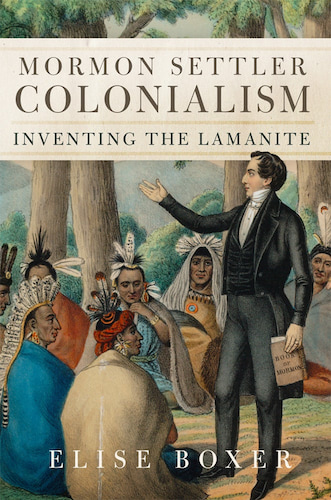
The study of race and Indigeneity within the Restoration has undergone a significant transformation in the last decade. If works by Matthew L. Harris and others have mapped the theological and political struggles of Black Saints, Elise Boxer’s Mormon Settler Colonialism: Inventing the Lamanite (University of Oklahoma Press, 2025) performs an equally vital—though still decidedly uncomfortable—unmasking of the structures governing Latter-day Saint relationships with Indigenous peoples, providing a theoretical framework to build upon in future works.
Boxer, a scholar of Indigenous Studies and a citizen of the Dakota Nation (Fort Peck), brings a lens to our history that many in the “Mormon Corridor” may find jarring. However, as someone who has spent years wrestling with the complexities of Utah history, I believe this is a volume that any scholar of Utah and Mormon history or student of the Restoration must grapple with.
Deconstructing the “Lamanite”
The core of Boxer’s argument is that the “Lamanite” is a colonial invention. While Latter-day Saints view the term as a scriptural identity laden with promises of future glory, Boxer utilizes a settler-colonial framework to argue that the categorization has functioned as a tool of dispossession. By placing Indigenous peoples into a Mormon-defined history—as descendants of a wayward branch of Israel who arrived around 600 BCE—the settler project effectively erases Indigenous creation stories and their ancestral claims to the land.
Boxer is at her most provocative when she suggests that depicting Indigenous peoples as “immigrants” (even ancient ones) serves to extinguish tribal title to the land. From her perspective, the Book of Mormon does not merely offer a spiritual heritage to Native Americans; it provides a religious justification for White settlers to claim “belonging” in a place where they were actually the latecomers.
The Continuity of the Colonial Project
The book is not merely interested in the 19th-century past. It forms a powerful trifecta with Hokulani K. Aikau’s Chosen People, A Promised Land, and Joanna Brooks’s Mormonism and White Supremacy by tracing how these racializing ideologies persisted into the modern era.
Boxer gives significant attention to the Indian Student Placement Program (ISPP) of the mid-to-late 20th century. For many Saints of a certain generation, this program is remembered as a benevolent effort to provide educational opportunities. Boxer, however, analyzes it through the cold light of cultural erasure, arguing that it was a continuation of the colonial effort to remove Indigenous children from their cultures and graft them into a White Mormon social order. She even points to current controversies—such as the debate over the removal of the pioneer mural in the Manti Temple or recent church manual language—to argue that Mormon settler-colonialism is a living, breathing structure.
Threading a Narrow Needle
As a reviewer, I will note that there are occasional minor factual errors—likely the result of Mormon Studies not being the author’s primary training—but these do not undermine the force of her theoretical intervention. My primary concern with the volume, however, is the rhetorical narrow needle Boxer sets up for future scholars to thread.
Throughout the book, Boxer levels critiques at established historians, including W. Paul Reeve, for what she perceives as a failure to center Indigenous voices correctly. She creates a dynamic where White scholars are caught in a double bind: if they do not focus on Indigenous disruption, they are accused of erasure; if they do mention it, they are accused of only using Indigenous suffering to bolster the settler-colonial narrative. While I appreciate the need to prioritize Indigenous voices, the path Boxer lays out for future interracial scholarship feels thin.
Furthermore, there is a palpable disconnect between the book’s initial stated aims and its ultimate content. In her introduction, Boxer indicates that she is providing a theoretical framework rather than a call for decolonization, stating: “This book is not a decolonization project… I am not calling for individual Mormon Indigenous members to denounce their membership or dismantle the LDS Church” (p. 23). Yet the text frequently pivots toward more radical demands. For example,
The Mormon settler colonial presence persists as Mormon settlers continue to live on stolen lands and reify Mormon settler structures that erase Indigenous peoples from their lands, history, and identity. My intention is to name and make visible Mormon settler colonialism and demonstrate its effectiveness in defining and naming Indigenous peoples as Lamanites using religious settler texts such as the Book of Mormon and the Doctrine Covenants. … Only when these Mormon settler infrastructures have been dismantled can Indigenous peoples exist on their own terms, a contradiction to the Mormon settler colonial project (pp. 157-159).
This internal tension makes the initial statement of purpose feel somewhat disingenuous and may hamper the book’s impact for those not already immersed in the specific rhetorical traditions of Indigenous Studies
The “Always-Future” Promise
Despite these concerns, Boxer hits the mark on several vital points. In discussing the Lamanite identity as laden with promises of future glory, she points out a recurring systemic pattern: that glory is perpetually deferred. Looking at the ISPP, Boxer notes that “Mormon settlers saw Indigenous peoples not as Mormon but instead as Lamanites even when ISPP children… wanted to be just Mormon” (p. 143). Because Mormon identity in the US was equated with Whiteness, Indigenous children were denied access to the “center.” This is a theme I’ve heard elsewhere, such as Ignacio Garcia’s memoir about his experience as a Latino Latter-day Saint, and the racial composition of the highest leadership of the Church also tends to indicate that there is truth to this assertion.
Conclusion
Mormon Settler Colonialism is an essential contribution to the field. It forces the reader out of hagiographic naivety and demands we look at our shared history from the perspective of those who were dispossessed by the “Kingdom of God.”
For info on more books being published in 2026, see Mormon Studies Books in 2026.