Our religion is fairly unique in that we (arguably) believe in a somewhat concrete, physical location for God’s abode. By the same token, I’ve kind of wondered whether the same can be said of, say, Outer Darkness (does one capitalize “outer darkness”? It seems a little inapt).
Our religion is also fairly unique in that hell is not described in terms of glowing hot coals or creative, clangy instruments of torture, but just….nothing. Total darkness. (There is one Biblical allusion to this that I’m aware of is in Jude that may have influenced the D&C imagery: “wandering stars, for whom blackest darkness has been reserved forever.”)
Religious skeptics point out that paradise typically has the characteristics that somebody in that society would see as ideal (e.g. for Arabs it’s watery fountains, for European peasants it’s Cockaigne where animals spread their own fertilizer directly in fields and cheese flies into your mouth), in that sense “seas of fire and glass” seems more grand, cosmological, and less culturally contingent (although we do have some of the streets paved with gold imagery as well). In much the same way “outer darkness” seems less culturally contrived and more cosmological than tortures that sound like they were thought up around a campfire.
I like the idea of hell as a simple antonym to heaven. If God is light and society and vivacity, hell is darkness and loneliness. It reminds me of a Truman Madsen quote I remember (but can’t find) where he talks about having a nightmare as a child of literally nothing, as if the empty darkness is the most terrifying prospect for human beings.
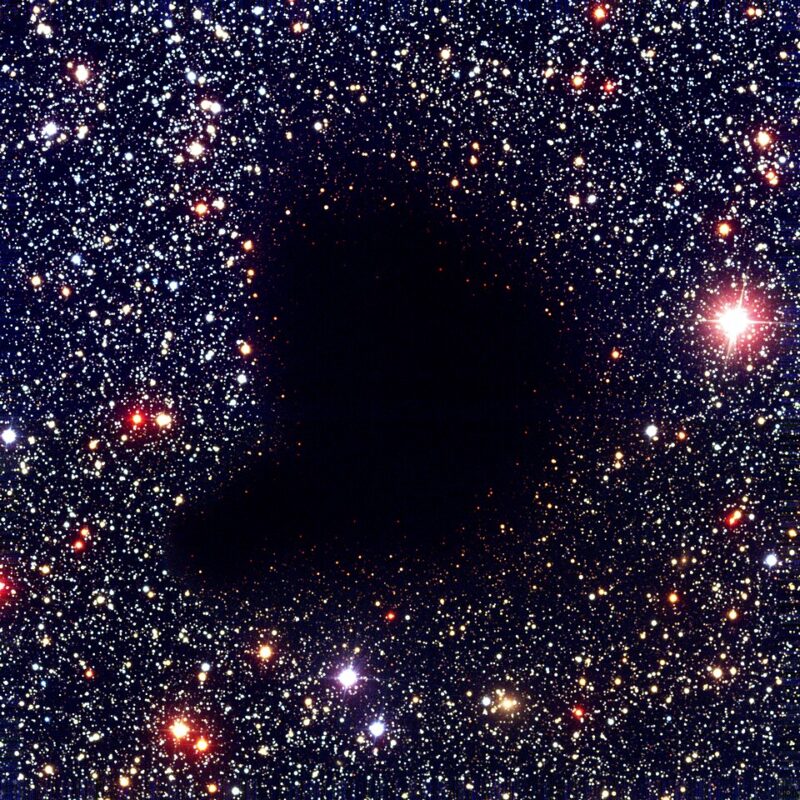
So I’ve wondered, in a pure speculative sense and not admitting to any insight into the reality of Outer Darkness, if there’s anywhere in the universe with the kind of cave darkness where you can’t see your hand in front of your face, but on for light years and light years “as far as the eye can see.” Something where the dimmest light from the stars doesn’t penetrate. If the sun is our symbol of celestial glory this would be a symbol of Outer Darkness.
It’s called the the Boötes Void (or “the Great Void), and if you were on a rogue planet in the middle of it with no star, the entire sky would be the blackest black, with no stars in sight. Near nothingness in absolute darkness going on for distances we cannot begin to grasp. On such a planet we would need 1960s level telescope to be able to detect the galaxies and the stars outside the void.
I’m not necessarily saying that Outer Darkness is in the Great Void, (or that Kolob is Sagitarrius A*, although earlier I indulged in some fun and harmless speculation about us being inside a black hole), but rather just making an interesting observation. God uses the brightness of the sun as an analogy for the highest kingdom, presumably so that we can viscerally get some taste of it in our limited mortal way. So what would the analogy would be for its opposite? With modern scientific technology we have indeed discovered places where “wandering stars [or rogue planets], for whom blackest darkness has been reserved.” Sun and stars give light and life to the universe (D&C 88: “Which light proceedeth forth from the presence of God to fill the immensity of space. The light which is in all things, which giveth life to all things”), but we have found places where light does not penetrate (at least enough for our eyes to detect it).
And if I was a non-believer one of the most depressing thoughts would be that, given our best cosmological guess, eventually the universe will all be one big void of Outer Darkness. The stars and galaxies will move farther and farther away, dimming the horizon until it’s like CS Lewis’ Hell of eternal twilight in the Great Divorce until the final blackout, and then nothing…forever. All the love, struggles, excitement, passions, beauty, grandeur, light, and life of the previous worlds will be reduced to floating masses of dark, inert, burnt out cinders “for whom blackest darkness has been reserved” forever.
P.S.
I wrote a similar piece on the end of the universe. A relevant passage.
In his book Until the End of Time: Mind, Matter, and Our Search for Meaning in an Evolving Universe Columbia University physicist Brian Greene quotes an interesting thought experiment…where they ask how what we think is meaningful would change if the universe were ending tomorrow. He then asks whether it makes a difference whether the universe was ending in a year, 10 years, 100 years, or a million years and then drives home the point that, since those increments are really basically the same compared to the eternal blackness afterwards, the end of the universe raises uncomfortable questions about why anything matters. (Contrast this with the very Latter-day Saint cosmological point made by non-Latter-day Saint scientist Freeman Dyson that “no matter how far we go into the future, there will always be new things happening, new information coming in, new worlds to explore, a constantly expanding domain of life, consciousness, and memory.”)
I admire Green’s willingness to grab the dilemma by the horns as a non-believer instead of just hand-waving it away (like many of them do).
Comments
8 responses to “Outer Darkness, Voids, Dark Nebulas, and the End of the Universe”
Back in the 80s on an excellent episode of St. Elsewhere, hell was depicted as being alone in a rowboat on Lake Powell. It was so bad that when Howie Mandel showed up for a few minutes during a near-death experience, the occupant of the rowboat begged him to stay. (OK, that was a cheap shot, but I couldn’t resist.)
For myself, I have decided that thinking about the afterlife in spatial terms in not helpful. Instead, I think of outer darkness as complete stagnation. You cannot learn anything new. You cannot create anything new. You just are what you are forever.
If our Heavenly Parents are outside of our Big-Bang-Universe, then they can probably handle anything. If they are inside of our Big-Bang-Universe, then they will have to do something about the far future. Michio Kaku, in his book Parallel Worlds, says that we will have to either figure out how to get into a different (and younger) universe, or we will have to time-travel back to a younger time in our own universe. And, you know, there are probably some other solutions as well. I’m confident that we can trust our Heavenly Parents on this one.
My mother thought of paradise as the light of christ and warmth comes with light. She felt outer darkness was dark and therefore cold. That has stuck with me.
The idea of the Atonement as an engine that turns back entropy has always been very appealing to me.
@ Last Lemming: I actually liked the Good Place because, regardless of the particulars, it got people thinking about the afterlife and what heaven and hell’s defining characteristics would be.
I like that framing of hell as well, it’s very Lewisian; the people in The Great Divorce who chose to stay in Hell couldn’t simply move on from the petty squabbles of their mortal lives.
@ Mark Ashurst-McGee: Oh definitely, the depression that comes with the idea of an Outer Darkness, end-of-universe situation is only applicable to atheists. Even deists would probably find the idea that a clock-setting God would just watch the universe die off forever a tough pill to swallow.
@ Mhermitmom & R: I agree. I’ve thought the same thing for both of those insights.
I think those who go to such a place are those who want nothing to do with the Lord or his Kingdom. They are so filled with wrath that they actually prefer to go to place beyond the precincts of the Kingdom. And in saying “place” I mean that the only thing that defines it as a place is that it is not the Kingdom. It is “without form and void” of order.
My take on outer darkness:
God loves all his children, and has created a plan that in the end gives everyone what they most want–what will make them happiest. Unfortunately, what some people most want is to exercise unrighteous dominion over others. To control. To abuse. If they want to change, God will do anything to make that happen. He’ll sacrifice his Son. He’ll put them through hell in the spirit prison if that’s what it takes. But if they utterly refuse to change, he will not force them. If they really want to spend eternity making other people miserable, he’ll let them.
What he won’t do is let them make his other children miserable–that ends with mortality. So he puts all these sons of perdition in one place so they can make each other miserable.
I presume God will make it a physically comfortable place if they’ll let him. But they’ve definitely “opted out” of all his efforts to make them better people: no influence of the Holy Ghost, no Light of Christ. So it’s the worst of the worst, at their worst; “L’enfer, c’est les autres” indeed. It sounds like an absolute nightmare to me, but it is the one place in all eternity where people can exercise unrighteous dominion over others, and for those who dwell there that makes it worth it.
I hope the experience will eventually cause them to change their minds, and I’m sure God will embrace them if they do. But maybe by the time they get there they’re beyond that point.
Similar to your idea of Outer Darkness (I like your capitalization of it when imagining it as a proper place) being a place without light, I like to think of the depth of the Atonement of Jesus Christ as being a place completely without the Light of God. “My God, why hast thou forsaken me?” is a natural plea when all light is withdrawn. In the physical world, absolute zero (-273.15°C, or -459.67°F) is the temperature when 100% of all heat is absent–the coldest of cold. Spiritually, the depth of the Atonement when the Savior felt all pains, sufferings, and sins, is spiritual “absolute zero”–the level completely without God’s light that cannot get any darker. Is Outer Darkness similar?