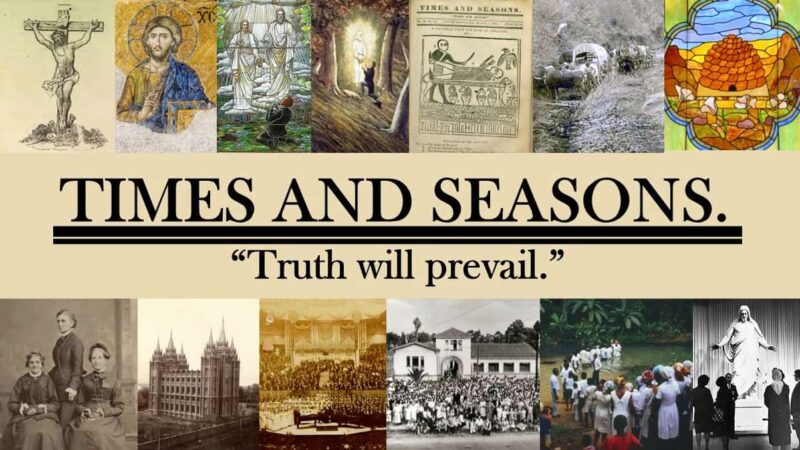

For me, this lesson (to be taught February 8th — I work 2 weeks ahead) might be one of the most important lessons of the whole Come Follow Me cycle. The example of Enoch and the idea of Zion, our utopian ideal, lead to important questions about what we do today and how we organize our society. Yes, it is not possible to actually achieve a utopia — but I think we talk about utopias because they lead us to think about what we are trying to reach, and how to get there.
So, especially today, shouldn’t we ask in this lesson whether our society should be built on loving one another? On being welcoming instead of hating and “deporting” the other? I guess what I’m suggesting is that we should make sure that the gospel drives our politics rather than the other way around. If your utopia is built on excluding anyone, on punishing instead of loving, on acquisition, on money, on making sure you are taking care of instead of we being taken care of, I can’t see how that utopia will lead towards Zion.
I can help build Zion.
I’d be interested to see how Zion is understood among different religions. The distance of the goal sometimes leads to despair about ever reaching it, and even an assumption that Zion is something God will impose on us. To my ears, the verb “build” comes across as particularly American, if not Mormon. We can’t just sit in comfort and wait for Zion to come, instead we should build Zion. And that is an idea I am completely behind.
However, in the American context “building” comes across as physical and transactional, something that is done once, by manipulating materials into objects that are ‘complete’ and that by their design will somehow create Zion. On the other hand, I don’t think we should limit Zion to “changing the hearts” of individuals. The structures around us, both physical AND social, have a lot to do with creating Zion. The laws we pass, the way we interact with one another, the expectations and requirements we make, all are part of creating Zion.
Here, the indefatigable Ruth May Fox, 3rd President of the Young Women, calls on the youth of the Church to build Zion:
Arise, O Youth
by Ruth May Fox
- Arise, O Youth, and follow in the steps
- Of that devoted band whose call divine
- To teach God’s truth and spread His marvelous work
- Was answered by a willingness sublime.
- O, blessed memory are they! As did
- Elijah’s mantle fall upon his friend
- With two-fold power, so may their loyalty,
- Their faith, upon the Youth of Israel descend.
- With such an heritage, O, Zion’s Youth,
- With dreams prophetic of a glorious goal,
- And God’s transcendent power to guide your steps
- You cannot fail the whisperings of your soul.
- The coming years are yours, O, valiant Youth,
- In which to test your knowledge, strength, and skill,
- Regenerate this suffering, sin-torn world
- And turn men’s hearts to do the Father’s will.
- The crisis of the ages knocks aloud,
- Is pleading at your door for help and trust;
- For you, O, Youth, to batter down the walls
- Of prejudice and selfishness and lust.
- Arm yourselves with justice, love, and truth,
- You’re sure to win – your Father’s at the wheel;
- Arise and shine; your armor waits for you,
- And untold glory shall reward your zeal.
- To build the towers of Zion is your right
- From their resplendent spires your songs shall ring
- ‘Tis yours to hear the standard of the Lord
- And yours to shout the triumph of the King.
1936
Jesus Christ is “the King of Zion.”
LDS teachings have somewhat replaced the idea of God as “King” with the idea of God as “Father”—and I’m still thinking about all the implications of this. For example, much of the difference comes down to how society is structured, what kind of government we have, and what happens when a subject/child disobeys. Nevertheless, our scriptures and theological conceptions are replete with references to God as “King”, and Christ coming to ‘rule’ over the earth as “the King of Zion.”
Here, the English convert Ida Emma Redding (who signed her poetry I. E. R.) gives her vision of Zion while she was living in London. A frequent contributor of poetry to the Millennial Star, she immigrated to Utah in 1856, and married Edward Sutherland in 1857, after which I don’t know anything about her.
The City of God
by Ida Emma Redding
- “The wilderness and solitary place shall be glad for them: the desert shall rejoice and blossom as the rose.”—-Isaiah.
-
-
-
- Zion! thou City of our God, rejoice!
- Jehovah speaks in love and praise of thee!
- Blessed among the nations! hear his voice:
- “City of my Redeemed! rise! be free!
- “Ye chosen Saints, who love to hear my word,
- “For you in mountain solitude doth spring,
- “While yet ye tremble at th’ oppressor’s sword,
- “The promis’d Zion of your Heav’nly King!”
-
-
- Then shall the wilderness rejoice, and blossom as the rose,
- When weary hearts within her walls shall find secure repose!
-
-
-
- Truth shall be in her palaces: her tow’rs,
- Fenc’d by a shield of adamantine faith,
- Impregnable shall stand: while Falsehood cow’rs
- Before the mighty arm of Him who saith,—-
- “Behold! I come, with an avenging band,
- “To judge-—condemn or recompense-—the world;
- “And they who seek to harm my chosen band,
- “Shall learn to tremble when my bolts are hurl’d;”
-
-
- “Fear not, belov’d of Israel’s God, though hellish foes oppress—-
- “My arm is stretch’d to save you still: my hand is rais’d to bless.”
-
-
-
- City of God! how glorious shalt thou stand!
- No more shall Lebanon exulting boast;-—
- How poor to thine the pride of Sharon’s land:
- How weak to thine the strength of Pharaoh’s host!
- Jehovah’s arm protects thee!-—vainly now
- The shafts of Satan speed their destin’d way:
- Calmly secure is thy majestic brow—-
- Omnipotence thy shield, and Christ thy stay!
-
-
- Yet how shouldst thou be ought but calm, aided by power divine:
- When Jesu’s care, and Jesu’s love, eternally arc thine?
-
-
-
- In thee the blind shall see—-the deaf shall hear,
- And the dumb mouth break forth with joy and sing:
- The barren land a thousand flow’rets bear,
- And in the desert living waters spring.
- Where once the rav’ning jaguar sought his prey,
- The homes of lore and calm content shall rise.
- Then, only then, the clear and living way
- Leads to bright lands beneath unfading skies.
-
-
- No evil, vain, or angry thought shall break its peaceful rest;
- The simple heart’s unerring guide, the pathway of the blest.
-
-
-
- No! sin may never enter there; nor ought
- Of violence or strife shall there abound:
- They, only they, who Jesu’s love have sought,
- And gladly hail’d the Gospel’s glorious sound:
- Jesu’s Redeem’d alone shall enter there,
- With songs of praise and everlasting joy,
- The light of immortality to share,
- And taste the bliss which knows of no alloy!
-
-
- With Him, their King, their long Beloved, through endless years to reign,
- With nought of worldly care or gloom to mar their rest again.
1852
God weeps—and rejoices—for His children.
It may be the idea of God as “King”, along with the trinitarian idea that God is “without body, parts or passions”, behind the lack of historical LDS poets portraying a God who weeps. On the other hand, we don’t seem to have a problem with a God who rejoices. And in some cases, we have a God who rejoices over Zion, or at least our preparations for Zion. Here English convert Charles W. Penrose, later an Apostle, sees the Gods rejoicing at the sight of His people building what would become Zion. Like Redding above, Penrose was still in England when he wrote this poem. He emigrated to Utah in 1861.
A Song
by Charles W. Penrose
- Come ye! Come ye! who pine for liberty,
- Who in a land that is with plenty blest,
- Linger in want and mourn in misery,
- Come to a land of freedom in the west.
-
-
- Come ye, Oh! come.
-
-
- Come to a land of freedom in the west.
- Come ye! Come ye! who grovel in despair,
- Who by the despot’s icy chains are bound,
- Arise, burst off your shackles, and prepare
- To dwell in peace, where justice reigns around.
-
-
- Come ye, Oh! come.
-
-
- To dwell in peace, where justice reigns around.
- Come ye! Come ye! whose hearts beat high with joy,
- Or soon will all your joy and pleasure cease,
- Jehovah soon, in anger will destroy
- All those who dwell not in this land of peace.
-
-
- Come then, Oh! come.
-
-
- All those who dwell not in this land of peace.
- Come then, Oh! come, it is a glorious land,
- A beauteous vale by mountains high encased,
- Where Saints of God, a loving happy band,
- Will dwell when haughty tyrants are abased.
-
-
- Come then, Oh! come.
-
-
- Will dwell when haughty tyrants are abased.
- Come then, Oh! come, for there will Zion be;
- Clothed in her glory, deck’d with jewels bright,
- There will her children dwell in unity,
- And Gods rejoice to gaze upon the sight.
-
-
- Come then, Oh! come.
-
-
- And Gods rejoice to gaze upon the sight.
1856
Jesus Christ will come again in the last days.
The second coming is frequently connected to the idea of Zion, with Christ coming to rule over Zion in the last days being expressed in many texts, both LDS and non-LDS. It is perhaps this connection that leads so often to our assumption that Christ will somehow impose Zion on us, despite the clear calls for us to build Zion. Here Eliza R. Snow (whose popularity and regard as an LDS poet means that we have more than 500 of her poems, all of which are in my database and which make up a large portion of the data) suggests that the second coming will come after “from the Rocky Mountain’s height / The little stone is rolling on” building Zion before His coming:
The Son of God Will Come
by Eliza R. Snow
- An angel from the upper heav’n,
- The “Everlasting Gospel” brought–
- The Priesthood unto man is giv*n,
- Which God to Enoch taught;
- And the renovation of earth is near–
- The Messiah’s kingdom will soon be here–
- Let the Saints prepare to meet him–
- The Son of God will come.
- Change, cloth’d with majesty and might,
- Will wield his wonder-working rod;
- Till Satan yields, and truth and light
- And peace are spread abroad:
- Till “the pow’rs that be” shall submit to one,
- And the will of God on the earth is done;
- Let the Saints prepare to meet him—-
- The Son of God will come.
- Lo! from the Rocky Mountain’s height
- The little stone is rolling on—
- The pure in heart behold the light
- Of the Millennial-dawn;
- And the veil of heav’n yet will open wide,
- And the ‘Groom descend to receive his bride;
- Let the Saints prepare to meet him—-
- The Son of God will come.
- The mighty in the heav’n of heav’ns,
- Who in celestial councils meet,
- Await the glorious signal giv’n
- When Zion is complete;
- And the Gods will shout thro’ the worlds on high,
- When they see him crown’d who came down to die;
- Then the Saints will shout in triumph,
- The Son of God has come.
1852