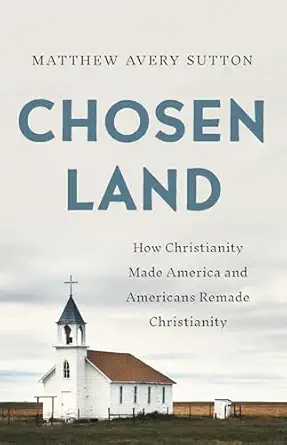
Matthew Avery Sutton, the Claudius O. and Mary Johnson Distinguished Professor of History at Washington State University, has long been a compelling chronicler of the intersection between apocalypticism and American power. His previous work, notably American Apocalypse, provided an essential roadmap for understanding the rise of modern evangelicalism. In his latest volume, Chosen Land: How Christianity Made America and Americans Remade Christianity (Basic Books, 2026), Sutton expands his scope to offer a sweeping, 500-year narrative that challenges standard assumptions about the secular nature of the American republic. For the Latter-day Saint reader, the book provides a sobering and vital context for where the Restoration fits within the broader, often violent, currents of American religious history.
The Myth of Neutrality
The central thesis of Chosen Land is that the “separation of church and state” was never the barrier to religious influence its founders—or modern secularists—imagined it to be. Instead, Sutton argues that the First Amendment acted as a “free-market catalyst.” By removing state funding, the Constitution forced Christian leaders to become “entrepreneurs of faith,” constantly reinventing their message to meet the social and political demands of the public.
This process created an unofficial, primarily White Protestant “quasi-establishment” that successfully wove its moral vision into the fabric of American law and policy. Sutton’s analysis of the “Four Streams” of American Christianity—Conservative, Revivalist, Liberal, and Liberationist—provides a useful taxonomy for understanding how these groups have vied for control of the “Chosen Land” narrative.
Mormonism as the “Stress Test”
For those of us interested in Mormon Studies, Sutton’s treatment of the Church of Jesus Christ of Latter-day Saints is particularly illuminating. He positions the early Church not merely as a peripheral movement, but as a significant “American original” that served as a case study of a significant stress test for American religious liberty.
Sutton effectively frames the 19th-century struggle for the “State of Deseret” and the subsequent legal battles over polygamy as a clash of sovereignties. The landmark case Reynolds v. United States (1879) is presented here as a pivotal moment in constitutional history—the point at which the Supreme Court decided that while the state could not police religious belief, it had every right to regulate religious action. Sutton’s narrative makes it clear that for the Protestant majority, “religious freedom” often meant the freedom to be some variety of Protestant; the Latter-day Saints were the group that most successfully forced the nation to define exactly where that freedom ended.
Where are the Reed Smoot Hearings?
The application of Sutton’s critical historical eye is occasionally uneven. While he utilizes high-level textual criticism to deconstruct the “invented traditions” of modern evangelicalism, he is less thorough when it comes to the specific history of the Church of Jesus Christ of Latter-day Saints’ transition into the American mainstream. For instance, despite the book’s deep dive into the legal limits of religious liberty via the Reynolds case, there is a notable absence of any discussion regarding the Reed Smoot hearings (1904–1907). The story that Sutton tells follows the traditional institutional narrative that the 1890 Manifesto was the end of polygamy, and the story ends there. Given the hearings’ massive impact on the national perception of Mormonism and its eventual political integration, as well as the negotiations around defining religious freedom in the United States that accompanied the hearings, the omission feels like a missed opportunity to further explore the book’s themes of religious “legitimacy” in a theoretically free-market landscape. Kathleen Flake’s book, The Politics of American Religious Identity: The Seating of Senator Reed Smoot, Mormon Apostle (University of North Carolina Press, 2004), would have been an extremely relevant resource to draw upon in this regard.
Conclusion
This missing piece of the puzzle is a minor aspect of the vast story that Sutton tells, and Chosen Land remains an indispensable work. Sutton’s ability to track the “death spiral” of the Mainline denominations alongside the rise of a more nationalistic, revivalist evangelicalism helps explain the current political landscape with startling clarity.
For Latter-day Saints, the book serves as a reminder of our complex heritage. We began as an exiled, “peculiar people” fleeing the very Protestant quasi-establishment Sutton describes, only to eventually become one of its most reliable allies in the defense of “traditional family values” in the late 20th century. Chosen Land is a masterclass in how religious identity is forged through conflict, and it is a vital resource for any student of the Restoration seeking to understand the American soil in which our faith was planted.
For info on more books being published in 2026, see Mormon Studies Books in 2026.
Comments
3 responses to “A Review: Chosen Land: How Christianity Made America and Americans Remade Christianity”
Thanks for this review. Although it’s not obvious from the title, Heath Carter’s recent article in the Atlantic “Americans should stop using the term Christian Nationalism” takes an extensive look at Sutton’s book as well.
Thanks for pointing that one out, Jonathan!
American is not necessarily Christian nation. The native americans were here thousands of years ago. They weren’t Christian. The Europeans brought Christianity.
Some assert that the founding fathers were Christian. But many were not. Jefferson edited the NT to takeout the miracles. Many were Unitarian theists. They clearly wanted separation between religion and government.
President Oaks wants religious freedom. Freedom from government interference. Others want freedom from religion. A government that is free from religious interference. Theoretically the 2 should be allies. But the bone of contention is social issues. Religion wants a say in areas it has no business being in. And secularists are too strident.
Right now the conservative religious right has the edge. An amoral President is pandering the conservatives. He’s stacked the Scotus with political hacks. And has a rubber stamp Congress. Hopefully, the pendulum will swing back.
America the beautiful is multicultural.